How Hard Is the Annapurna Base Camp Trek?
Anos Tamang
Founder and trekking guide, Shamar Treks
Almost every page answering this question says "moderate" and moves on. That word is doing no work. A trek can be moderate because it is short, because it is low, or because the ground is easy — and Annapurna Base Camp is only one of those three.
Here is what the difficulty actually consists of, with the numbers.
The three numbers people ask for
| Measure | Figure | What it means in practice |
|---|---|---|
| Highest point | 4,130 m | Low for a base camp — no acclimatisation day required |
| Walking distance | About 70 km from Kimche | Modest. This is not the hard part |
| Cumulative ascent | Roughly 5,000 m | This is the hard part, and nobody publishes it |
Those three lines explain the whole trek. The distance is unremarkable, the altitude is manageable, and yet people finish day two with legs that do not work. The reason is the third row.
Distance depends entirely on where you start
Published distances for this trek range from about 70 km to over 110 km, and both are correct — they are measuring different walks.
The trail historically began on foot at Birethanti, near Nayapul. A road now reaches Kimche on the way in and Siwai on the way out, which removed roughly two days of farmland and dusty river valley at each end. Starting from the current roadhead, the round trip is in the region of 70 km. Quoting 110 km is describing a walk most people no longer do.
Treat any distance figure you see without a stated start point as unusable.
Cumulative ascent is the number that matters
Net elevation gain from Kimche (1,640 m) to Base Camp (4,130 m) is about 2,490 m. If the trail climbed steadily, this would be an easy week.
It does not. The Modi Khola valley is steep-sided, and the path repeatedly drops to a river and climbs the far side. Add the descents back in and you are climbing in the order of 5,000 m over the trip — roughly twice the net figure.
The worst of it has a name.
The Chhomrong staircase
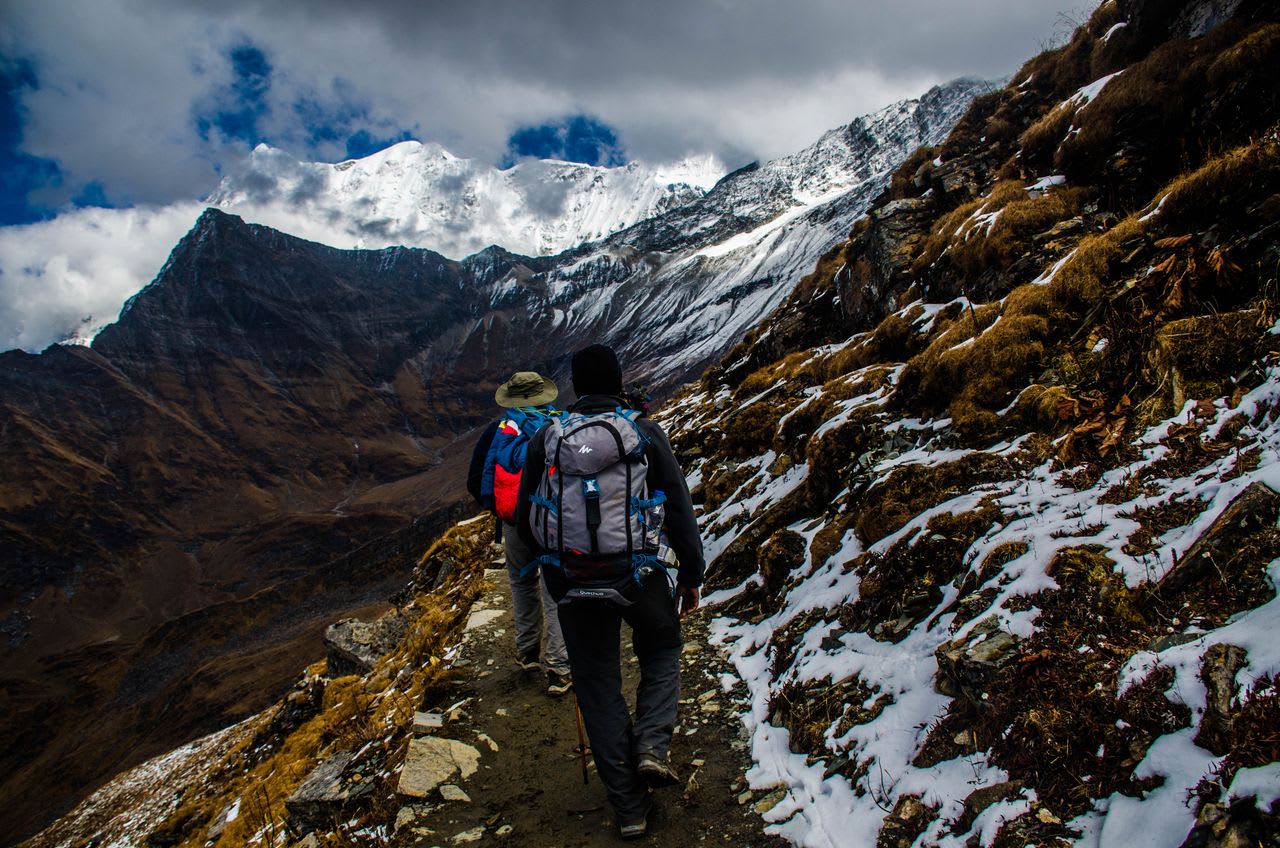
Chhomrong sits on a steep hillside at 2,170 m. Leaving it, the trail descends several hundred stone steps to the Chhomrong Khola at the bottom of the valley, crosses a suspension bridge, and climbs every one of those metres back up the other side to Sinuwa.
Net gain for that section: about 140 m. Your legs will disagree.
And you do it twice — once walking in, once walking out. There is no alternative route. Ask anyone who has done this trek what they remember and a high proportion will say "the steps".
Why altitude is not the problem here
At 4,130 m, Annapurna Base Camp is more than 1,200 m below Everest Base Camp and over 1,400 m below Kala Patthar. Acute mountain sickness becomes a serious planning constraint above roughly 4,500 m; below it, a steady ascent is generally tolerated without a dedicated rest day.
That is why a seven-day itinerary is honest here and would be reckless in Khumbu. Nothing is being cut to make it short.
It does not mean altitude is absent. You will be slower above Deurali, you will breathe harder on the last hour into Base Camp, and a minority of people get a headache at 4,130 m. If you have reacted badly to altitude before, read our piece on altitude sickness in Nepal and tell your guide before you start, not on the night it happens.
The day-by-day difficulty, honestly
| Day | Hours | What makes it hard |
|---|---|---|
| 1 | 4–5 | A climb to Chhomrong after a morning sitting in a jeep |
| 2 | 5–6 | The staircase. The hardest day, and it is the second one |
| 3 | 5–6 | Sustained climbing as the gorge narrows; first night above 3,000 m |
| 4 | 5–6 | Thin air for the last hour, after an early start |
| 5 | 6–7 | Over 1,800 m of descent. Quads, not lungs |
| 6 | 4–5 | The staircase again, in reverse |
Note where the hard days sit. Most treks ease you in; this one puts its worst climbing on day two and its worst descent on day five. If you are going to struggle, you will know early — which is arguably an advantage.
A fitness test that is actually predictive
Forget "can you walk 10 km". The question is whether you can climb and descend repeatedly on consecutive days.
- Can you climb 600–800 m of hill in a morning without it ruining your afternoon?
- Can you do that again the next day, and the day after?
- Can you descend 1,000 m without your knees complaining for two days afterwards?
Three yeses and the trek will be enjoyable rather than survived. The third question is the one people fail, and it is the one that stairs at home prepare you for better than flat distance does.
Poles are not optional equipment on day five. They are the difference between arriving at Bamboo tired and arriving unable to face day six.
How it compares with other treks in the region
| Trek | Highest point | Days | Harder or easier |
|---|---|---|---|
| Ghorepani Poon Hill | 3,210 m | 4–5 | Easier — shorter, lower, fewer repeats |
| Mardi Himal | 4,500 m | 5 | Comparable, with a higher finish |
| Annapurna Base Camp | 4,130 m | 7 | — |
| Everest Base Camp | 5,545 m | 14 | Harder — altitude becomes the constraint |
If ABC sounds like more than you want, Poon Hill is the honest downgrade and we will say so. If it sounds like less, the comparison that matters is with Everest, and we have written about choosing between Everest and Annapurna separately.
Who finds this trek hard
In our experience, in this order: people who train on flat ground, people who skip poles, people who carry too much, and people who treat day two as a warm-up.
Age is a poor predictor. We have had walkers in their late sixties finish comfortably and twenty-five-year-old gym regulars struggle on the descent, because a gym does not teach quadriceps to brake for six hours.
What else decides whether it goes well
Difficulty is only one input. The weather at Base Camp determines what you actually see, and the lodges and food determine how well you recover between days. Both are covered separately because both deserve more than a paragraph.
If you want the route itself laid out — where the road now reaches, and the single gap you enter the Sanctuary through — that is in the route, mapped.
And if you have decided you want to go, our seven-day Annapurna Base Camp trek sets out the dates, the inclusions and the one section of this trail that carries real objective risk.
About Anos Tamang
Founder and trekking guide, Shamar Treks
Anos Tamang is the founder of Shamar Treks and a working trekking guide. He leads trips across Nepal's trekking regions and writes here about the practical side of them — routes, permits, seasons and the decisions that make the difference on the trail.