
Annapurna Region, Nepal
Mardi Himal Trek
Four days on a ridge directly beneath Machhapuchhre — a trail only opened in 2012, and the short trek in the Annapurnas that rewards the effort most.
Package Overview
Best Time to Visit
October to December, March to May
Guided & Permitted
Licensed, insured guide and all trekking permits included
What four days buys you here
Four days is the shortest schedule that still puts you above the treeline for two nights, and that is the whole value of this booking. Shorter versions exist and they all make the same cut: they drive higher, skip a night on the crest, and turn the summit morning into a rushed there-and-back.
What you are paying for is time on the Mardi ridge rather than time getting to it. You sleep on it twice. Machhapuchhre is out of your door at both ends of the day, and the two best hours of light on this trek — dusk at Low Camp, dawn above High Camp — are both hours you would otherwise be walking through or missing entirely.
Three days is possible. We do not sell it, because the thing you would be cutting is the only thing that makes the trek distinctive.
Sleeping above the treeline in a four-day window
The trade-off is compression. You go from 820 m in Pokhara to sleeping at 3,580 m on the third night, and that is quick by any standard.
It works because the walking days are short. Nobody is asked to cover distance and altitude on the same day, which leaves your body the afternoons to catch up — the reason we arrive at Low Camp and High Camp by mid-afternoon rather than pushing on while there is still light. Guides on this route are instructed to arrive early rather than far.
It also means the summit morning is deliberately unhurried. We leave before dawn for temperature and light, not to make up time.
The honest difficulty — and one thing to plan for
Graded moderate. The daily distances are short but the gradient is consistently steep, particularly the climb from Deurali to Forest Camp and again from Low Camp to High Camp.
The maximum sleeping altitude is 3,580 m at High Camp, and the Upper Viewpoint reaches around 4,500 m. In four days that is a fast ascent profile. Mild altitude symptoms at High Camp are not unusual, and the morning push to Upper Viewpoint is where people feel it. Going slowly on that climb is the whole technique.
High Camp fills, and there is no alternative
This is the practical thing to know about Mardi that does not apply to other Annapurna treks. High Camp has limited rooms, limited water in the dry months, and no other lodge within reach. In peak season it genuinely fills.
We book ahead and we start early on day three. An operator who tells you booking is unnecessary on this route has not run it in October.
Mardi Himal or Annapurna Base Camp?
The question we are asked most often about this trek, so here is the comparison plainly.
| Mardi Himal | Annapurna Base Camp | |
|---|---|---|
| Days needed | 4 | 7–12 |
| Highest point | ~4,500 m (day walk) | 4,130 m (sleeping) |
| Terrain | Ridge, open, views both sides | Valley, enclosed, opens at the end |
| The payoff | Machhapuchhre at close range | Standing inside a ring of 7,000 m peaks |
| Crowds | Moderate | Busier |
| Weather risk | High — the ridge is the view | Lower — the Sanctuary works in cloud |
If you have a fortnight, do both; they share a trailhead region and the combination is excellent. If you have four days, this is the better trek. If the weather forecast is poor, Annapurna Base Camp is the safer booking because a cloudy day there still has a trek in it.
What you are sleeping in, night by night
There are no villages on this route, so there are no village prices and no village comforts. Every bed you use was built for trekkers, which cuts both ways: the rooms are newer than on the old trails, and there is no family kitchen to fall back on when the lodge runs short.
| Night | Altitude | What to expect |
|---|---|---|
| Pitam Deurali | 2,100 m | Warmest night, largest choice of lodges, hot shower usually available |
| Low Camp | 2,970 m | Comfortable, busy, reliable food and power |
| High Camp | 3,580 m | Cold, cramped, water rationed in dry months, no alternative lodge |
Prices for everything except your room rise with each camp, because it was all carried up. Charging, bottled water and a bucket of hot water are paid extras and cost noticeably more at High Camp than at Deurali — budget roughly double for the same items at the top.
Blankets are provided everywhere and are not enough at High Camp. Bring a bag rated to -10°C and use it over the blankets rather than instead of them.
The one risk worth pricing in before you book
On most treks a grey day costs you a view. On this one it costs you the trek, because you are paying for two days on an open crest and cloud removes the entire reason to be up there.
We cannot sell you weather, so we do the next best things. Departures are set on the days the forecast supports where your dates allow it. If day three looks poor, we will suggest holding at Low Camp and taking the summit morning a day later rather than walking up into cloud on schedule — a change that costs one lodge night, not the trip. And we tell clients with a single fixed window in August or September to book something else.
If your dates are immovable and the forecast is against you, Annapurna Base Camp is the more robust booking, because the Sanctuary is worth walking into in any weather.
Who should not book this trek
Said plainly, because it saves everyone trouble.
- Anyone who needs a guaranteed private room every night. High Camp cannot promise that in October, whatever anyone tells you at booking.
- Anyone who has never slept above 3,000 m and is anxious about it. The profile here is fast. Poon Hill tops out a thousand metres lower.
- Anyone travelling in the monsoon with no date flexibility. See above.
- Anyone who dislikes steep descents. The Siding side is a long, sustained drop and there is no gentler way off this ridge.
Everyone else — including reasonably fit first-time trekkers in Nepal — finds this the best four days available from Pokhara, and we would say so even about a trek we did not sell.
Finishing at Siding rather than back to Kande
Most operators walk you back down the way you came. We descend the far side to Siding, a working Gurung village on the Seti side of the ridge, and drive out from there.
It costs nothing extra, it avoids repeating a day, and Siding sees a fraction of the trekkers that the Kande side does. The descent is long and steep — this is the day poles earn their place — but it is a better end to the trek.
Permits
An ACAP entry permit and a TIMS card, both included and arranged in Pokhara. You need your passport and passport photographs.
Where this trek goes
- Pokhara — A lakeside town at 820 m with the Annapurnas 30 km away
Related activities: Trekking in Nepal.
Or compare every trip we run: all trekking and tour packages.
Trip Highlights
Two days walking a ridge rather than a valley floor
Machhapuchhre's south face close enough to read its texture
Upper Viewpoint at around 4,500 m, reached and returned in a morning
Moss and lichen cloud forest below Low Camp
Finishes at Siding, a working village most trekkers never see
Live Weather
Detailed Itinerary
1
Day 1: Pokhara to Kande, trek to Pitam Deurali (2,100 m)
A 45-minute drive to Kande, then a steady climb past Australian Camp — itself a well-known viewpoint — to Pitam Deurali on the ridge. Three to four hours. A short first day by design: it puts you on the ridge and leaves the long climb for tomorrow with fresh legs.
2
Day 2: Pitam Deurali to Low Camp (2,970 m)
Five to six hours and the day that surprises people. The trail enters dense cloud forest — oak and rhododendron hung with moss and lichen, damp and silent — and climbs steadily through Forest Camp. The trees thin near Low Camp and the ridge opens with Machhapuchhre suddenly very close.
3
Day 3: Low Camp to High Camp (3,580 m)
Four to five hours on the open ridge, and the best walking of the trek. The treeline gives way to low shrub and grass, with the Modi Khola valley falling away on one side and the Seti on the other. An early start matters — High Camp has limited rooms and the afternoon cloud usually builds by one o'clock.
4
Day 4: Upper Viewpoint (~4,500 m), descend to Siding and drive to Pokhara
Pre-dawn start for the climb along the ridge towards Mardi Himal Base Camp, reaching the Upper Viewpoint under the south face of Machhapuchhre. Two to three hours up, going deliberately slowly. Then back to High Camp for breakfast and a long descent — five to six hours, steep on tired legs — to Siding, and the drive back to Pokhara.
Cost Details
What's Included
- Private transport, Pokhara to Kande and Siding to Pokhara
- All lodge accommodation on trek, twin share
- Breakfast, lunch and dinner throughout the trek
- High Camp booked in advance
- Licensed, insured English-speaking trekking guide
- ACAP entry permit and TIMS card
- Guide wages, insurance, equipment, food and accommodation
- First aid kit carried by the guide
- Government taxes and company service charge
What's Not Included
- International flights and Nepal visa
- Travel insurance
- Accommodation and meals in Pokhara
- Porter — available on request
- Hot showers, wifi, battery charging and bottled drinks in lodges
- Personal trekking equipment and sleeping bag
- Tips for guide and porter
Essential Information
- Maximum altitude: 4,500 m
- Trip duration: 4 days
- Difficulty: moderate
- Best season: October to December, March to May
- Group size: 1 to 12 trekkers
- Permits: ACAP entry permit; TIMS card — all included and arranged by us
- Accommodation: Lodges and trail camps, twin share
- Guide: licensed and insured, English speaking
- Weather reference point: Mardi Himal High Camp
Important Cost Information
Payment Terms:
- • 25% deposit required to confirm booking
- • Balance payment due 30 days before departure
- • Full refund if cancelled 45+ days before
Fixed Departure Dates
Choose from our scheduled group departures with guaranteed departures.
Route Map
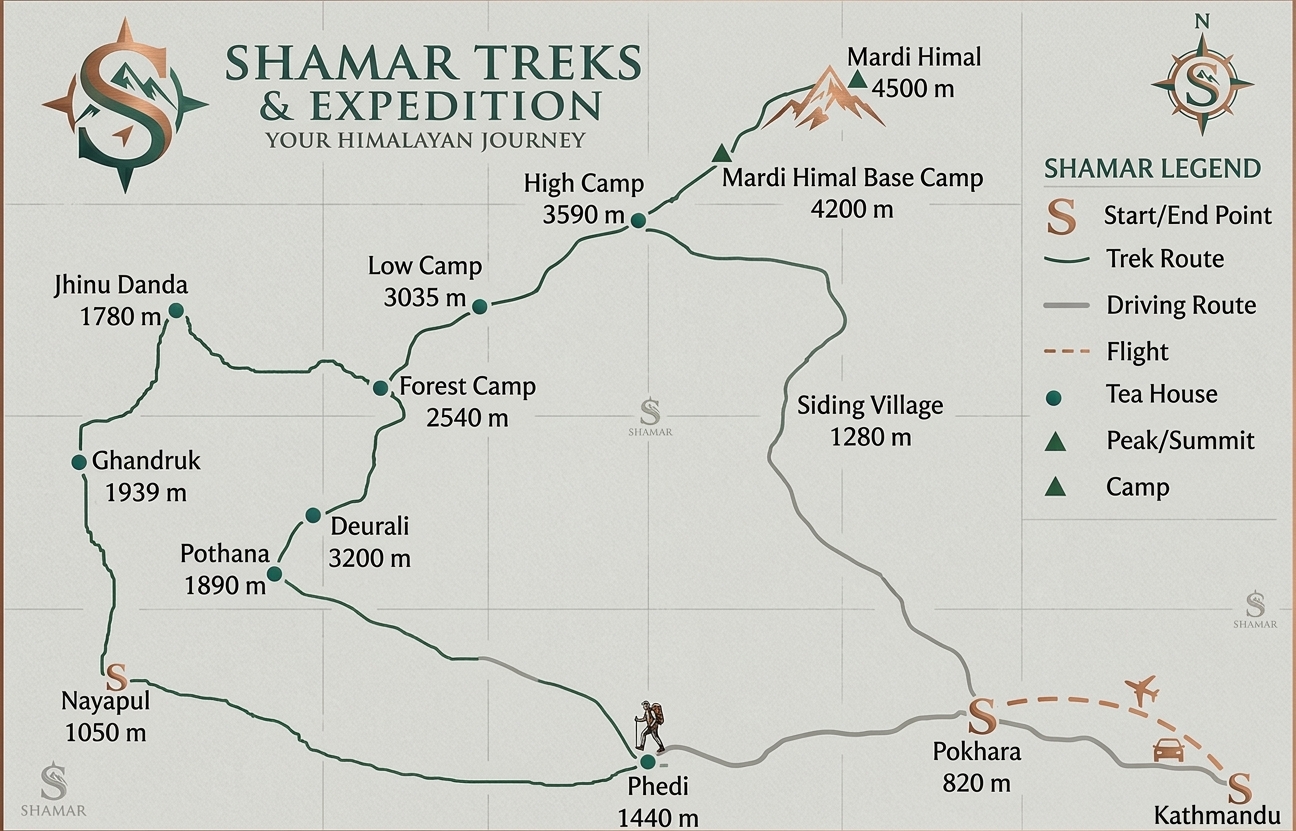
Route map image could not be loaded
Showing route for Mardi Himal Trek
Route Information
Starting Point:Kande
Ending Point:Siding
Highest Point:Upper Viewpoint (4,500 m)
Key Locations
Kande
Day 1
start
1,770 m
Pitam Deurali
Day 1
2,100 m
Low Camp
Day 2
2,970 m
High Camp
Day 3
3,580 m
Upper Viewpoint
Day 4
viewpoint
4,500 m
Siding
Day 4
end
1,750 m
Frequently Asked Questions
Yes, and this is the standard itinerary. Five days is more comfortable if you want a shorter final day, splitting the descent with a night at Siding. Four works well for most people and is why the route suits a tight schedule.
Still have questions?
Our travel experts are here to help you plan the perfect trip. Get in touch with us for personalized advice.
Reviews & Ratings
—
0 reviews
5★
0
4★
0
3★
0
2★
0
1★
0
Share Your Experience
Have you completed this trek? Help other travelers by sharing your experience.