
Langtang Region, Nepal
Ruby Valley Trek
Nine days across the Ganesh Himal foothills between the Langtang and Manaslu trails — homestays rather than lodges, a 3,850 m pass, and a stretch of country most trekkers in Nepal have never heard of.
Package Overview
Best Time to Visit
March to May, October to December
Guided & Permitted
Licensed, insured guide and all trekking permits included
The gap on the map between Langtang and Manaslu
Draw a line between the Langtang trail and the Manaslu Circuit and there is a wide block of mountain country in the middle with a 7,422 m peak in it. That is the Ganesh Himal, and the walking route through it is called the Ruby Valley.
Almost nobody goes. The Annapurna region takes well over a hundred thousand trekkers a year; this trail sees a tiny fraction of that, and on most days in season you will pass no other foreign walkers at all. That is not a marketing line — it is a consequence of there being no lodges, which is the fact this whole page is really about.
Why it is called Ruby Valley
Not a brand. There are genuine corundum deposits in these hills, and the mineral workings around Somdang — historically for zinc and lead as much as for gemstones — are the reason a rough road exists up there at all.
You will walk past the workings. Do not expect a mine tour or a gem shop; expect a scar on a hillside, some abandoned plant, and a village that has had a complicated relationship with extraction for decades. It is an interesting half hour and it explains the valley's name honestly, which most operators do not bother to do.
Homestays, not lodges — read this part properly
This is the single thing that decides whether you will enjoy this trek. There is no teahouse infrastructure. You sleep in people's houses.
| Ruby Valley homestay | A standard teahouse trek | |
|---|---|---|
| Room | A room in a family home, sometimes shared | A private twin with a lockable door |
| Bathroom | Outside or shared, often a squat toilet | Shared, usually indoors |
| Washing | A bucket of hot water if you ask | A paid hot shower most nights |
| Food | What the household is eating | A menu with a dozen choices |
| Electricity | Solar, intermittent | Mains or reliable solar, paid charging |
| Language | Nepali and Tamang; your guide translates | Some English almost everywhere |
If the left-hand column reads as an adventure, this is one of the best treks in Nepal. If it reads as a list of problems, book Langtang instead — it leaves from the same road head, has proper lodges, and we will not think less of you for it.
The pass, and the view that justifies the week
Pangsang Pass at 3,850 m is the high point and it is unusual in what it shows you. Most Nepali passes give you one range. Pangsang sits on a broad grassy col positioned between three, so on a clear morning you get the Ganesh Himal immediately north, the Langtang peaks east, and Manaslu west — three separate massifs from one standing position.
It is also, being grass rather than rock and scree, a place you can comfortably sit for an hour. We time the crossing for late morning when the cloud that builds over the Ganesh has usually not yet arrived.
How hard is it, really?
Moderate, and harder than the altitude suggests. Nothing on this trek goes above 3,850 m, so acute mountain sickness is a minor concern. The effort comes from the shape of the country: this is a route that crosses ridges rather than following a valley, so you climb and descend repeatedly rather than gaining height once.
Expect five to seven hours most days, with two days over 1,000 m of ascent. Trails are earth and root rather than the engineered stone staircases of the Annapurna foothills — easier on the knees, worse in the wet, and occasionally indistinct enough that a guide is not optional.
Who lives here
The villages divide roughly by altitude and history. Gatlang and the settlements on the Langtang side are Tamang — Tibetan-descended, Buddhist, with the characteristic stone-and-timber houses and a large mani wall in the centre of the village. Tipling and Sertung further west are mixed Gurung and Tamang, and Tipling notably has both a gompa and a church, which is a rarer combination in the hills than people expect.
These are farming communities where trekking income is a supplement, not the economy. The consequence is a reception that is curious rather than practised — and an expectation that you will behave like a guest in a house, because you are one.
Two days that surprise people
The Somdang road
A rough mining track reaches Somdang, which means part of one day is spent walking on a road with occasional traffic. It is the least attractive stretch of the trek and it is short. We would rather flag it than have you discover it.
The descent to Tipling
A long drop of well over 1,000 m off the pass into the Ankhu Khola valley, mostly on steep earth trail. It is the hardest single day on the knees and the one where poles matter.
Permits
The route clips the edge of Langtang National Park to cross Pangsang, so you need:
- Langtang National Park entry permit
- TIMS — Trekkers' Information Management System card
Both included and arranged by us in Kathmandu. This is not a restricted area, so there is no special permit and no government liaison officer — but we do set a two-person minimum on this trek for practical reasons, because homestay logistics in villages this small work badly for a single walker.
Season
October to early December is the best window — clear, stable, and the harvest is in, which is a genuinely good time to be staying in farming villages. March to May is warm with rhododendron on the ridges and hazier peaks.
We do not run this in the monsoon. The trails are earth, the leeches are serious, and the Ganesh Himal sits under cloud for weeks. Deep winter closes Pangsang with snow and empties the higher homestays.
Where this trek goes
- Kathmandu Valley — Seven UNESCO Monument Zones within an hour of each other
Related activities: Trekking in Nepal, Village Homestays in Nepal.
Or compare every trip we run: all trekking and tour packages.
Trip Highlights
Pangsang Pass (3,850 m) with Ganesh Himal, Langtang and Manaslu from one ridge
Ganesh Himal I (7,422 m) at close range, on a trail almost nobody walks
Homestays throughout — this route has no lodge infrastructure
Gatlang, Tipling and Sertung: Tamang and Gurung villages, not trekking stops
The Somdang mineral workings the valley takes its name from
Starts from the Langtang road head, no internal flight
Live Weather
Detailed Itinerary
1
Day 1: Kathmandu to Syabrubesi (1,550 m)
Seven to eight hours by private jeep up the Trishuli gorge on the Langtang road — sealed at first, then rough, narrow and slow. A tiring day and the only one spent entirely in a vehicle. Overnight in a lodge at Syabrubesi, which is the last place on this trek with reliable hot water and a menu.
2
Day 2: Syabrubesi to Gatlang (2,240 m)
Four to five hours climbing away from the river on a good trail to Gatlang, a large Tamang village set on a hillside of terraced fields with a lake and a long mani wall below it. This is the first homestay night and the gentlest introduction to it — Gatlang has hosted trekkers on the Tamang Heritage route for years and knows what a visitor needs.
3
Day 3: Gatlang to Somdang (3,270 m)
Five to six hours and around 1,000 m of climbing, partly on the rough mining track that serves the workings at Somdang. The walking is less attractive than the rest of the trek and the reward is the position: a high, cold settlement under the Ganesh Himal, with the peaks close enough to hear the ice move at night. Homestay or a basic workers' lodge.
4
Day 4: Somdang to Pangsang Pass (3,850 m) and down to Tipling (1,890 m)
The defining day, and a long one at seven to eight hours. Two hours or so up to the broad grassy col at Pangsang, where Ganesh Himal, Langtang and Manaslu are all visible on a clear morning — three separate ranges from one place. Then a sustained descent of nearly 2,000 m into the Ankhu Khola, which is very hard on the knees. Tipling is a mixed Gurung and Tamang village with both a gompa and a church.
5
Day 5: Tipling to Sertung (2,050 m)
Five to six hours contouring west across the valley, crossing the river and climbing again through terraced farmland and small hamlets. A shorter day after the pass, and the most sociable one — the trail passes through several settlements and you will be invited to stop in at least one of them. Homestay in Sertung.
6
Day 6: Sertung to Jharlang (1,700 m)
Five to six hours on a rolling trail through mixed forest and farmland, dropping gradually as the country softens. Ganesh Himal stays behind you for most of the morning. Jharlang is a Tamang village and the last high-value homestay night of the trek.
7
Day 7: Jharlang to Darkha (1,600 m)
Five to six hours through the lower Ankhu Khola on a well-used village trail — rice terraces, water mills, suspension bridges, and a change of vegetation as the altitude comes off. This is farming Nepal rather than trekking Nepal, and it is a good last full day of walking.
8
Day 8: Darkha to Dhading Besi, drive to Kathmandu
A short walk of two to three hours to the road at Darkha Phedi, then a jeep down to Dhading Besi and on to Kathmandu — around five to six hours of driving in total on progressively better road. Arrive in the evening.
9
Day 9: Kathmandu — spare day
Kept deliberately free. This trek ends on rough roads in a district where a landslide or a broken bridge can add half a day, and a spare night in Kathmandu is far better than a missed international flight. If everything runs to plan it is a free day in the city, and we can arrange a guided tour of the valley's temple sites if you want one.
Cost Details
What's Included
- Private jeep, Kathmandu to Syabrubesi and Dhading Besi to Kathmandu
- All homestay accommodation on trek
- One lodge night at Syabrubesi
- Breakfast, lunch and dinner throughout the trek
- Licensed, insured English-speaking guide with Tamang or Nepali language
- Langtang National Park entry permit and TIMS card
- Guide wages, insurance, food and accommodation
- First aid kit carried by the guide
- One spare night in Kathmandu against road delays
- Government taxes and company service charge
What's Not Included
- International flights and Nepal visa
- Travel insurance — must cover helicopter evacuation
- Accommodation and meals in Kathmandu beyond the spare night
- Porter — available on request at a daily rate
- Bottled drinks and any paid charging
- Personal trekking equipment, sleeping bag rated to -10°C, and poles
- Tips for guide and porter
- Any cost arising from early descent, evacuation or road closure
Essential Information
- Maximum altitude: 3,850 m
- Trip duration: 9 days
- Difficulty: moderate
- Best season: March to May, October to December
- Group size: 2 to 10 trekkers
- Permits: Langtang National Park entry permit; TIMS card — all included and arranged by us
- Accommodation: Family homestays throughout, one lodge night at Syabrubesi
- Guide: licensed and insured, English speaking
- Weather reference point: Somdang
Important Cost Information
Payment Terms:
- • 25% deposit required to confirm booking
- • Balance payment due 30 days before departure
- • Full refund if cancelled 45+ days before
Fixed Departure Dates
Choose from our scheduled group departures with guaranteed departures.
Route Map
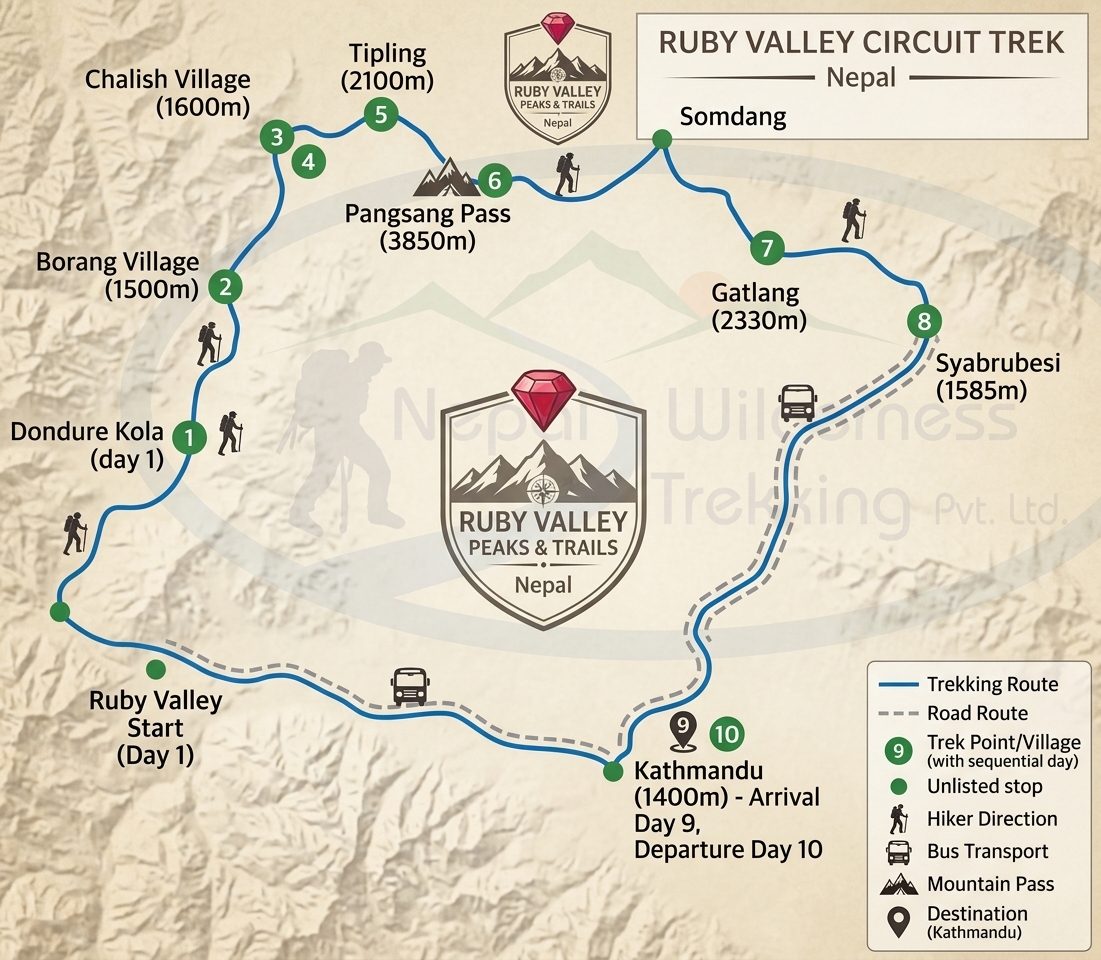
Route map image could not be loaded
Showing route for Ruby Valley Trek
Route Information
Starting Point:Syabrubesi
Ending Point:Darkha
Highest Point:Pangsang Pass (3,850 m)
Key Locations
Syabrubesi
Day 1
start
1,550 m
Gatlang
Day 2
2,240 m
Somdang
Day 3
3,270 m
Pangsang Pass
Day 4
landmark
3,850 m
Tipling
Day 4
1,890 m
Sertung
Day 5
2,050 m
Jharlang
Day 6
1,700 m
Darkha
Day 7
end
1,600 m
Frequently Asked Questions
In the Ganesh Himal, the block of mountain country between the Langtang and Manaslu trails, spanning Rasuwa and Dhading districts north-west of Kathmandu. It starts from Syabrubesi, the same road head as the Langtang trek, and finishes on the Dhading side.
Still have questions?
Our travel experts are here to help you plan the perfect trip. Get in touch with us for personalized advice.
Reviews & Ratings
—
0 reviews
5★
0
4★
0
3★
0
2★
0
1★
0
Share Your Experience
Have you completed this trek? Help other travelers by sharing your experience.