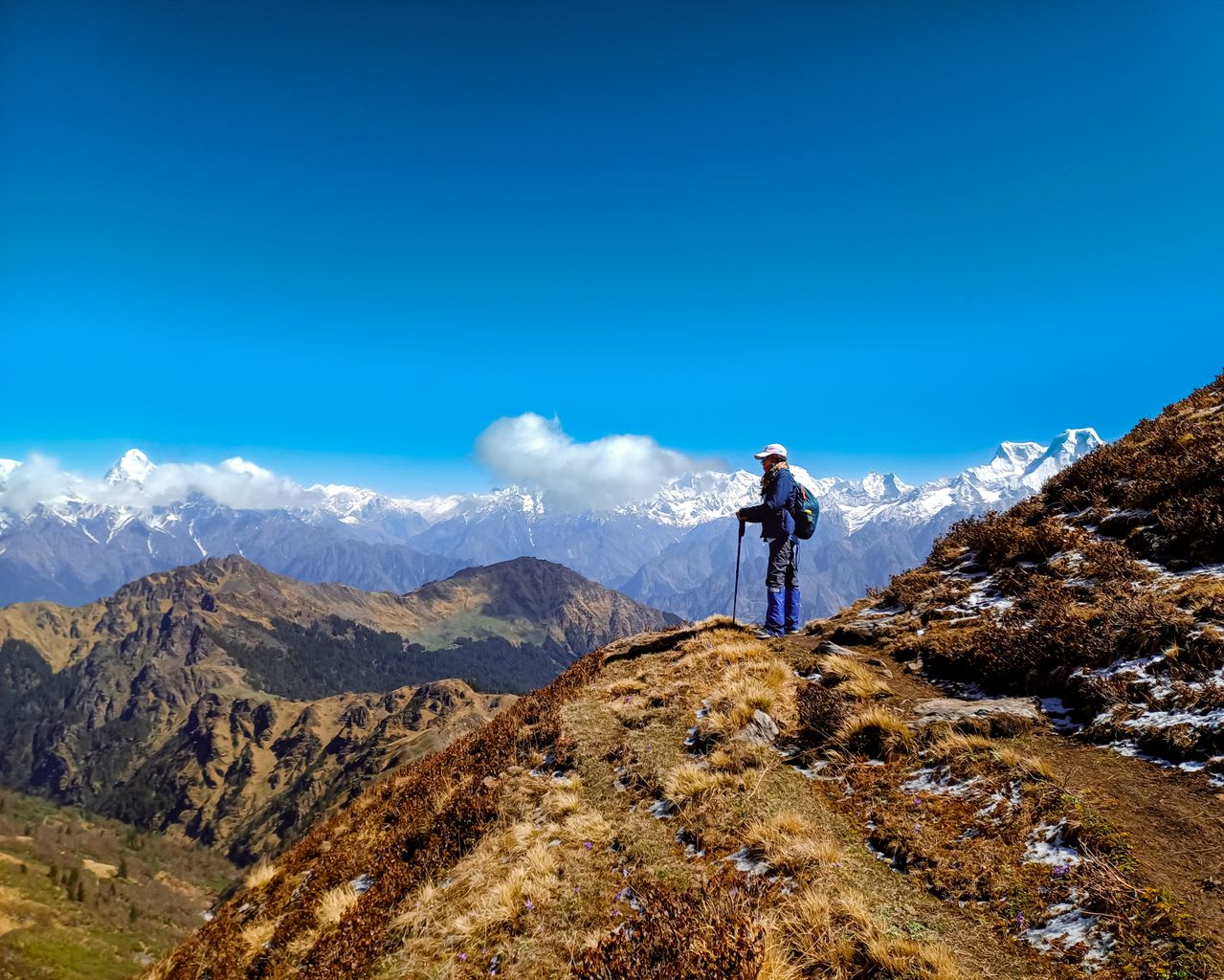
Annapurna Region, Nepal
Kori Danda Trek
Four days to a 3,800 m grazing ridge on the eastern side of the Annapurnas — the aspect almost nobody photographs — starting from Sikles, among the largest and least altered Gurung villages in Nepal.
Package Overview
Best Time to Visit
March to May, September to November
Guided & Permitted
Licensed, insured guide and all trekking permits included
The side of Annapurna nobody photographs
Almost every famous Annapurna viewpoint looks at the range from the south or the west. Poon Hill, Muldai, Khopra, Mardi, Annapurna Base Camp — all of them face the wall built around Annapurna South, Hiunchuli and Machhapuchhre.
Kori Danda faces east, and the mountains change completely. Annapurna II (7,937 m) and Annapurna IV (7,525 m) dominate instead, with Lamjung Himal (6,983 m) in front of them and Machhapuchhre reduced to a shape off to the west. These are the peaks at the far end of the Annapurna Circuit, the ones you spend days walking towards in the Manang valley — and here you are looking straight up at them after two days out of Pokhara.
At 3,800 m Kori is also the highest of the short trekking viewpoints within easy reach of the city, higher than Mardi's Low Camp, Muldai, Khopra Danda or Poon Hill.
Sikles is the point, not just the trailhead
Most treks start at a road-end with a tea shop. This one starts in a village of several hundred slate-roofed stone houses stacked up a hillside at 1,980 m, which is one of the largest Gurung settlements in the country and among the least rebuilt.
The people here are Tamu — the Gurung name for themselves — and Sikles has historically sent its sons into the Gurkha regiments, which is why you will find retired soldiers who served in Hong Kong or Brunei sitting outside houses their grandfathers built. The village also sits at the heart of where the Annapurna Conservation Area Project did its earliest work in the 1980s, making local management of forest and grazing the model rather than a fenced-off park.
What this means practically is that Sikles is not a trekking economy. The fields are worked, the livestock matter, and you are a guest rather than a customer. We stay in a village homestay on the last night rather than a lodge, deliberately.
Why four days is the right length
Kori is sold as anything from three to six days and the versions are genuinely different trips.
| Version | What it does | The catch |
|---|---|---|
| 3 days | Sikles, then a very long push to Kori and out | Around 1,800 m of gain in one day; most people suffer |
| 4 days (this trek) | Splits the climb, night on the high pasture, night in Sikles | None worth mentioning |
| 6 days | Adds Kapuche Lake and Hugu Goth | Two extra days for one lake and a lower valley |
The four-day shape splits the 1,820 m climb from Sikles to Kori across two days, which is the whole reason it works. It also gives you a night in the village on the way down, when you are finished walking and can actually spend time there.
Kapuche Lake — worth a detour or not?
Kapuche sits at 2,546 m below the Annapurna II ice fall and is described, accurately, as the lowest glacial lake in Nepal. Glacial lakes of that character normally sit above 4,000 m; this one is fed directly by ice collapsing off the face above it, which is why it exists so low.
It is genuinely striking and it is in the wrong direction. Reaching it properly means dropping into the Madi valley towards Hugu Goth and climbing back out, which is what turns a four-day trek into six. We do not bolt it on as a rushed half-day, because that produces a long walk to a viewpoint above the lake rather than time at it.
If Kapuche is what you want, tell us and we will quote the six-day version that does it justice.
The difficulty, and the one day that is long
Moderate overall, with a distinct shape: two days up, one long day down.
| Day | Walking | Height change | Notes |
|---|---|---|---|
| 1 | Drive 2–3 hrs, walk 4–5 hrs | +900 m from Sikles | Climb begins immediately after the drive |
| 2 | 3–4 hrs | +900 m | Short but thin air; open ground |
| 3 | 6–7 hrs | −1,820 m | The whole descent in one go |
| 4 | Drive 2–3 hrs | — | Village morning, then out |
Day three is the honest one. Coming off Kori to Sikles gives back every metre of the climb in a single day, much of it on steep pasture and forest trail rather than engineered steps. Poles matter. So does starting early enough that you are not doing the last hour in the dark.
What the high pasture is like to sleep on
Nights one and two are spent on grazing ground, not in villages. The buildings up here are kharka — seasonal herders' shelters and the simple lodges that have grown beside them — and they operate on the same calendar as the livestock. Outside the main seasons some are closed entirely.
Expect a plain room or a shared dormitory space, blankets, an outside toilet, water from a spring or carried, and food cooked on wood or gas. There is no menu to speak of: there is dal bhat, and there is tea. It is warm, it is filling, and above 3,000 m it is the right thing to be eating anyway.
Because capacity is measured in beds rather than rooms, we confirm space before departure. In late October there is not a spare bed to be had on that ridge.
A trail with some history under it
The route through Sikles and up onto these pastures forms part of the network the Swiss geologist Toni Hagen walked in the 1950s while surveying Nepal on foot — a period in which he covered around 14,000 km through the country, at a time when almost no outsider had seen most of it.
That is not a reason to book a trek. It is a reason to notice, while you are walking, that this is a working route between settlements and pastures that people used long before anyone thought of it as recreation. The trail does not go where it goes for the views.
Permits
Kori sits inside the Annapurna Conservation Area, so you need:
- ACAP — Annapurna Conservation Area Project entry permit
- TIMS — Trekkers' Information Management System card
Both included, both arranged by us in Pokhara before departure. Bring your passport and two passport photographs. The ACAP checkpoint on the Sikles road records your details for search and rescue.
Season, and what closes
Late September to November is the best window: clear air, the pastures still open, and Annapurna II at its sharpest. March to May works well, warmer, with rhododendron in the forest belt on the way up.
Winter is the one to check with us. Kori at 3,800 m holds snow, and more importantly the seasonal kharka lodges close when the herds come down, which can make the high nights unavailable rather than merely cold. Monsoon is poor here for the usual reasons plus one specific to this route — the pasture crossing is hard to follow in cloud.
If you want the same region without the altitude, Khumai Danda sits on a neighbouring ridge at 3,245 m and runs in three days. For the same eastern peaks from the other side, the Annapurna Circuit spends days beneath them.
Where this trek goes
- Pokhara — A lakeside town at 820 m with the Annapurnas 30 km away
Related activities: Trekking in Nepal.
Or compare every trip we run: all trekking and tour packages.
Trip Highlights
Kori Danda (3,800 m) — the highest short-trek viewpoint near Pokhara
Annapurna II, Annapurna IV and Lamjung Himal from the east, close and unobstructed
Sikles: among Nepal's largest Gurung villages, still farming rather than hosting
Optional detour to Kapuche Lake, the lowest glacial lake in Nepal
Part of the old Toni Hagen walking route through the Annapurna foothills
Almost no other trekkers, four days, no flight
Live Weather
Detailed Itinerary
1
Day 1: Pokhara to Sikles (1,980 m), climb to the high kharka (about 2,900 m)
Two to three hours by jeep north-east from Pokhara on a rough road to Sikles — around 47 km but slow going. Time to walk through the village before the climb starts, then four to five hours up through oak and rhododendron to the grazing ground above, where the herders' kharka and its simple lodge sit at roughly 2,900 m. A long day, and the reason the next one is short. The view opens behind you as you climb, back down the Madi valley.
2
Day 2: Kharka to Kori Danda (3,800 m)
Three to four hours and only about 900 m, but it is thin-air walking on open ground with no shelter. The forest ends and the route crosses high pasture where herders' paths fan out in every direction — this is the section that needs a guide who knows the line, particularly if cloud comes up. Kori Danda is a broad grazing ridge rather than a summit, with Annapurna II and IV directly across the valley and Lamjung Himal in front of them. Afternoons are frequently clear; sunset here is the reason you came.
3
Day 3: Kori Danda to Sikles (1,980 m)
Sunrise on the ridge, then the descent — six to seven hours and 1,820 m, giving back the whole climb in one day. Steep pasture at first, then forest trail, much of it on earth and root rather than built steps, so it is hard work on the knees in a different way from the stone staircases further west. We aim to be down by mid-afternoon with time in the village. Homestay in Sikles: a family house, a shared meal, and the best night's sleep of the trip.
4
Day 4: Sikles to Pokhara
A slow morning in the village — the Gurung houses, the fields, the retired Gurkhas who will happily talk if you have an hour — and then the two to three hour jeep back to Pokhara, arriving early afternoon.
Cost Details
What's Included
- Private jeep, Pokhara to Sikles and return
- Two nights in kharka lodges on the high pasture
- One night in a family homestay in Sikles
- Breakfast, lunch and dinner throughout the trek
- Beds confirmed in advance, where capacity on the ridge is limited
- Licensed, insured English-speaking guide who knows the pasture route
- ACAP entry permit and TIMS card
- Guide wages, insurance, food and accommodation
- First aid kit carried by the guide
- Government taxes and company service charge
What's Not Included
- International flights and Nepal visa
- Travel insurance — must cover helicopter evacuation
- Accommodation and meals in Pokhara
- Porter — available on request at a daily rate
- Kapuche Lake extension — quoted separately as a six-day trek
- Charging, bottled drinks and any hot water in kharka lodges
- Personal trekking equipment, sleeping bag rated to -10°C, and poles
- Tips for guide and porter
- Any cost arising from early descent or trip changes
Essential Information
- Maximum altitude: 3,800 m
- Trip duration: 4 days
- Difficulty: moderate
- Best season: March to May, September to November
- Group size: 1 to 10 trekkers
- Permits: ACAP entry permit; TIMS card — all included and arranged by us
- Accommodation: Kharka lodges on the high pasture, homestay in Sikles
- Guide: licensed and insured, English speaking
- Weather reference point: Sikles
Important Cost Information
Payment Terms:
- • 25% deposit required to confirm booking
- • Balance payment due 30 days before departure
- • Full refund if cancelled 45+ days before
Fixed Departure Dates
Choose from our scheduled group departures with guaranteed departures.
Route Map
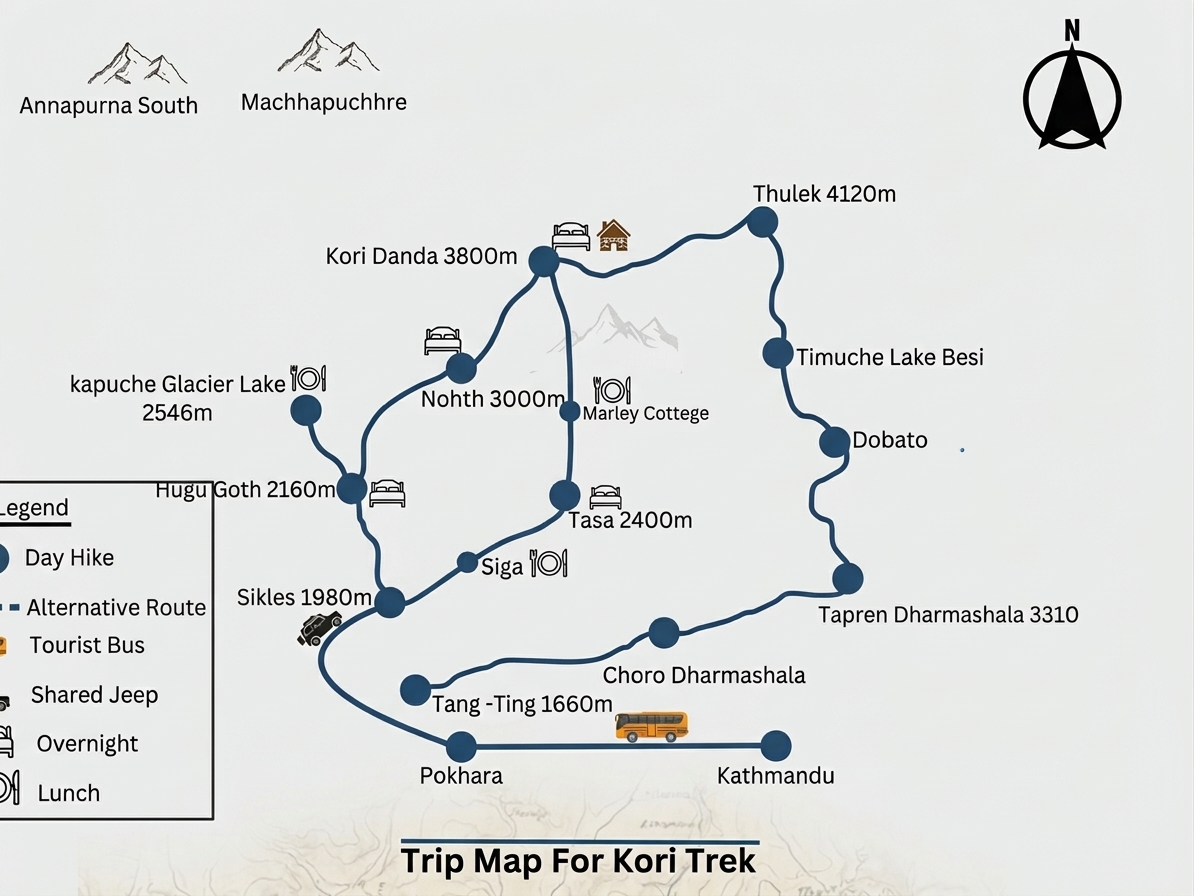
Route map image could not be loaded
Showing route for Kori Danda Trek
Route Information
Starting Point:Sikles
Ending Point:Sikles
Highest Point:Kori Danda (3,800 m)
Key Locations
Sikles
Day 1
start
1,980 m
Kharka above Sikles
Day 1
2,900 m
Kori Danda
Day 2
3,800 m
Sikles
Day 3
end
1,980 m
Frequently Asked Questions
Kori Danda is 3,800 m, which makes it the highest of the short-trek viewpoints within easy reach of Pokhara — higher than Poon Hill, Muldai, Khopra Danda or Mardi Himal's Low Camp. You sleep on the ridge at Kori on night two.
Still have questions?
Our travel experts are here to help you plan the perfect trip. Get in touch with us for personalized advice.
Reviews & Ratings
—
0 reviews
5★
0
4★
0
3★
0
2★
0
1★
0
Share Your Experience
Have you completed this trek? Help other travelers by sharing your experience.