
Muktinath & Jomsom, Nepal
Dhaulagiri Base Camp & French Pass Trek
Sixteen days beneath the seventh-highest mountain on earth, over French Pass at 5,360 m into the Hidden Valley and down to Mustang — a full camping expedition with no lodges above Italian Base Camp.
Package Overview
Best Time to Visit
April to May, October to early November
Guided & Permitted
Licensed, insured guide and all trekking permits included
The hardest trek we sell, and we will talk you out of it if we should
This page is going to spend more time on difficulty than on scenery, because that is the useful thing for a reader to know. The Dhaulagiri Circuit is routinely described as one of the hardest trekking routes in Nepal, and that description is accurate.
You cross French Pass at 5,360 m and Dhampus Pass at about 5,234 m within three days of each other, sleeping at over 5,000 m in the Hidden Valley in between. There are no lodges above Italian Base Camp, no villages for six days, no road, and no easy way off the route once you are committed to the gorge.
If you want an 8,000 m mountain at close range without this level of commitment, the Annapurna Circuit with Tilicho Lake crosses a comparable pass with lodges every night and a road never more than a day away. That is not a lesser trek; it is a different proposition.
What a supported camping expedition actually involves
Most trekkers in Nepal have only ever done teahouse trekking. This is a different activity and it is worth setting out plainly.
| This trek | A teahouse trek | |
|---|---|---|
| Sleeping | Two-person tent on the ground, every night above Italian BC | A room with a bed |
| Eating | Cooked by our kitchen crew from carried supplies | Ordered from a lodge menu |
| Washing | A bowl of warm water outside the tent | A paid hot shower |
| Toilet | A toilet tent | A shared bathroom |
| Warmth | Your sleeping bag; there is no stove to sit by | A heated dining room in the evening |
| Crew | Guide, cook, kitchen hands and porters — often 8 to 12 people | A guide, sometimes a porter |
| If you want to stop | There is nowhere to stop | The next village |
The crew is the reason this works. A well-run camping trek is more comfortable than people expect — hot food appears, tents are pitched before you arrive, and the kitchen is genuinely good. What it never is, is warm. At 5,050 m in a tent, your sleeping bag is the only heat source there is.
The altitude profile, and the one thing that goes wrong
The single greatest risk on this trek is being high for too long with no way to descend quickly.
From Italian Base Camp at 3,660 m you climb through Japanese Base Camp at 4,200 m to Dhaulagiri Base Camp at 4,750 m, then over French Pass at 5,360 m to sleep in Hidden Valley at around 5,050 m. That is three consecutive nights above 4,700 m with one pass already behind you and another in front.
The itinerary includes acclimatisation days at Italian Base Camp and Dhaulagiri Base Camp, and they are not optional. Anyone who is not acclimatising properly by Dhaulagiri Base Camp does not go over French Pass — the correct decision is to descend the way you came, and our guides are instructed to make it.
The reason this matters more than on other treks: once you are over French Pass, the only ways out are forward over Dhampus Pass or back over French Pass. There is no valley to walk down. That is why the decision is made before the pass, not after it.
The Chonbarden gorge
Above Italian Base Camp the route enters the Chonbarden gorge, and this is where the trek stops feeling like walking. The trail crosses glacier moraine, boulder fields and, depending on the season, sections of ice where the crew may fix a rope for security.
It is not technical climbing and you do not need mountaineering skills. You do need to be comfortable moving over unstable ground, using your hands occasionally, and being roped for short stretches if conditions require it. Crampons are carried and are sometimes used on the pass and in the gorge.
Hidden Valley, which is exactly what it sounds like
Over French Pass the route drops into a high basin at around 5,050 m ringed by peaks, with no permanent inhabitants, no vegetation to speak of and no route in or out except over a pass at either end. It is a genuine high desert and one of the strangest places in Nepal.
We camp there for a night. It is the coldest night of the trek by a considerable margin and, for most people who do this route, the one they remember.
Coming out into Mustang
Dhampus Pass drops you towards Marpha and Jomsom on the Kali Gandaki — apple orchards, a whitewashed Thakali village, and a sudden return to lodges, hot showers and other people after ten days of tents.
The contrast is one of the genuine pleasures of this route. Marpha is known for its apple brandy and for being one of the best-kept villages in Nepal, and arriving there off the Dhampus Pass is a considerably better way to see it than arriving by jeep.
From Jomsom you can fly to Pokhara — a short, dramatic, weather-dependent flight — or drive. We plan on the road and treat the flight as a bonus, because a weather-cancelled Jomsom flight at the end of a sixteen-day trip is a poor way to finish.
Who this is for, said plainly
- Right for you if you have crossed a 5,000 m pass before, you have camped at altitude, and you are comfortable being six days from a road.
- Wrong for you if this would be your first Nepali trek, or your first time above 4,500 m, or if you have not slept in a tent in cold conditions.
- A conversation if you have done Everest Base Camp or the Annapurna Circuit and want the next thing. Call us — we would rather assess it honestly than sell you a trip you will not enjoy.
Permits
- ACAP — the route exits through the Annapurna Conservation Area
- TIMS — Trekkers' Information Management System card
This is not a restricted area, so there is no agency-only permit. Both are included. The two-person minimum is ours, and on a trip requiring a full expedition crew it is not negotiable.
Season
This trek has the narrowest weather window of anything we run. April to May and October to early November, and within those, the middle weeks.
Too early in spring and the passes are deep in snow. Too late in autumn and the cold at 5,050 m becomes genuinely dangerous. Winter is out of the question, and the monsoon makes the lower approach dangerous and the gorge impassable. If your dates are fixed outside these windows, we will tell you to book something else.
Where this trek goes
- Muktinath & Jomsom — A temple at 3,800 m held sacred by Hindus and Buddhists alike, in the arid Kali Gandaki valley
- Pokhara — A lakeside town at 820 m with the Annapurnas 30 km away
Related activities: Trekking in Nepal, Mountaineering Expeditions.
Or compare every trip we run: all trekking and tour packages.
Trip Highlights
Dhaulagiri I (8,167 m), the seventh-highest mountain in the world
French Pass (5,360 m) and Dhampus Pass (about 5,234 m) in three days
Hidden Valley — a high desert basin with no permanent inhabitants
The Chonbarden gorge, a route with genuine expedition character
Finishes in Marpha and Jomsom, on the edge of Mustang
Fully supported camping with cook and crew, no lodges above 3,660 m
Live Weather
Detailed Itinerary
1
Day 1: Kathmandu to Pokhara, drive to Beni (830 m)
Six to seven hours by road west to Pokhara and then on to Beni, the district headquarters of Myagdi at the confluence of the Myagdi Khola and the Kali Gandaki. The last day with reliable shops, so any final kit purchases happen here. Overnight in a lodge.
2
Day 2: Beni to Darbang, trek to Dharapani (1,560 m)
Two to three hours by jeep up the Myagdi valley to the roadhead at Darbang, then three to four hours of walking through subtropical farmland and Magar villages. Warm, green, terraced country — deceptively gentle, and the last easy day for a fortnight. First night under canvas.
3
Day 3: Dharapani to Muri (1,850 m)
Five to six hours on village trails through rice terraces and small settlements, crossing side streams and climbing gradually. Muri is a substantial Magar village with views opening north towards Dhaulagiri and Gurja Himal. The crew and the rhythm of camp life settle in around now.
4
Day 4: Muri to Boghara (2,080 m)
Six to seven hours on a rolling, sometimes rough trail that drops to the Myagdi Khola and climbs again. The valley narrows noticeably and the farmland begins to give way to forest. Boghara is the last significant village on the route — from here the country empties out completely.
5
Day 5: Boghara to Dobang (2,520 m)
Five to six hours through dense forest on a trail that is frequently indistinct and occasionally washed out, following the river upstream into an increasingly enclosed valley. This is the day people realise the trek has stopped being a walk between villages. Camp in a forest clearing.
6
Day 6: Dobang to Italian Base Camp (3,660 m)
Six to seven hours and a big climb, leaving the forest behind and emerging into open moraine country with Dhaulagiri I finally visible ahead. Italian Base Camp is the last place on the route with any shelter beyond tents, and the gateway to the Chonbarden gorge. The air is noticeably thinner here.
7
Day 7: Italian Base Camp — acclimatisation day
Not optional. We walk several hundred metres up the moraine and return to camp, which is what makes the days above possible. It is also the last realistic point to turn around without committing to the gorge, and the guide will give an honest assessment of how the group is doing.
8
Day 8: Italian Base Camp to Japanese Base Camp (4,200 m)
Five to six hours into the Chonbarden gorge — glacier moraine, boulder fields and, depending on conditions, sections of ice where the crew may fix a rope. Not technical climbing, but this is where the trek stops feeling like walking. Camp on the glacier side beneath enormous walls.
9
Day 9: Japanese Base Camp to Dhaulagiri Base Camp (4,750 m)
Four to five hours up the glacier to the base camp beneath the north face and icefall of Dhaulagiri I. It is an extraordinary position — 8,167 m of mountain rising directly above a tent — and a serious altitude to be sleeping at. Short day by design.
10
Day 10: Dhaulagiri Base Camp — acclimatisation day
The decision day. We climb a few hundred metres towards the Dhaulagiri north-east col and return, both to acclimatise and to assess. Anyone not adapting properly by this evening does not cross French Pass, because beyond it there is no valley to walk down — only another pass. Our guides are instructed to make that call without hesitation.
11
Day 11: Dhaulagiri Base Camp over French Pass (5,360 m) to Hidden Valley (about 5,050 m)
The crux. A pre-dawn start for a steady three to four hour climb on snow and scree to French Pass, where the Hidden Valley, Mukut Himal and Tashi Kang open out ahead and Dhaulagiri stands behind. Then a descent into the basin itself — a high desert with no inhabitants, no vegetation and no way out except over a pass at either end. The coldest night of the trek, by a long way.
12
Day 12: Hidden Valley over Dhampus Pass (about 5,234 m) to Yak Kharka (3,680 m)
Seven to eight hours and a huge day. A short climb to Dhampus Pass with the Annapurnas and Nilgiri suddenly in view across the Kali Gandaki, then a very long descent of over 1,500 m on loose scree into grazing country. Hard on the knees and a relief to the lungs. Camp at Yak Kharka above Marpha.
13
Day 13: Yak Kharka to Marpha (2,670 m)
Three to four hours down into the Kali Gandaki valley and into Marpha — whitewashed Thakali village, apple orchards, narrow flagstoned streets and lodges. After ten nights in a tent, a room with a door is a significant event. Marpha is known for its apple brandy and you will have earned some.
14
Day 14: Marpha to Jomsom, drive to Pokhara
A short walk or drive to Jomsom, then the long journey down the Kali Gandaki by jeep to Pokhara — eight to ten hours on rough road. The alternative is the short Jomsom to Pokhara flight, which we can arrange at extra cost; it is dramatic and weather-dependent, so we plan on the road and treat the flight as a bonus.
15
Day 15: Pokhara to Kathmandu
Six to seven hours by road, or a 25-minute flight at additional cost. Arrive in Kathmandu in the afternoon. After sixteen days this is the point at which most people discover they are considerably hungrier than they realised.
16
Day 16: Kathmandu — spare day
Reserved against weather on the passes, a delay on the Kali Gandaki road, or a slower crossing than planned. On a trek with this little margin, a spare day is not padding — it is the difference between a weather delay costing you a night in Pokhara and costing you your flight home.
Cost Details
What's Included
- All road transport, Kathmandu to Beni and Pokhara to Kathmandu
- Jeep transfer to the roadhead at Darbang
- Full expedition crew: guide, cook, kitchen staff and porters
- All tents, kitchen equipment, toilet tent and camp meals
- Lodge accommodation at Beni and Marpha
- Breakfast, lunch and dinner throughout the trek
- Two acclimatisation days, at Italian Base Camp and Dhaulagiri Base Camp
- Group safety equipment including rope and crampons where conditions require
- ACAP entry permit and TIMS card
- Licensed, insured guide experienced on French Pass
- Crew wages, insurance, equipment, food and accommodation
- Comprehensive first aid kit, pulse oximeter and emergency oxygen
- One spare day against weather on the passes
- Government taxes and company service charge
What's Not Included
- International flights and Nepal visa
- Travel insurance — must cover helicopter evacuation to 6,000 m, and we will ask to see it
- Accommodation and meals in Kathmandu, and in Pokhara beyond the listed night
- Optional Jomsom to Pokhara and Pokhara to Kathmandu flights
- Personal equipment: sleeping bag rated to -25°C, insulated mat, down jacket
- Bottled drinks and any charging
- Tips for guide, cook and porters
- Any cost arising from an aborted pass crossing, early descent or evacuation
Essential Information
- Maximum altitude: 5,360 m
- Trip duration: 16 days
- Difficulty: expert
- Best season: April to May, October to early November
- Group size: 2 to 8 trekkers
- Permits: ACAP entry permit; TIMS card — all included and arranged by us
- Accommodation: Full camping for ten nights above Italian Base Camp; lodges at Beni and Marpha
- Guide: licensed and insured, English speaking
- Weather reference point: Dhaulagiri Base Camp
Important Cost Information
Payment Terms:
- • 25% deposit required to confirm booking
- • Balance payment due 30 days before departure
- • Full refund if cancelled 45+ days before
Fixed Departure Dates
Choose from our scheduled group departures with guaranteed departures.
Route Map
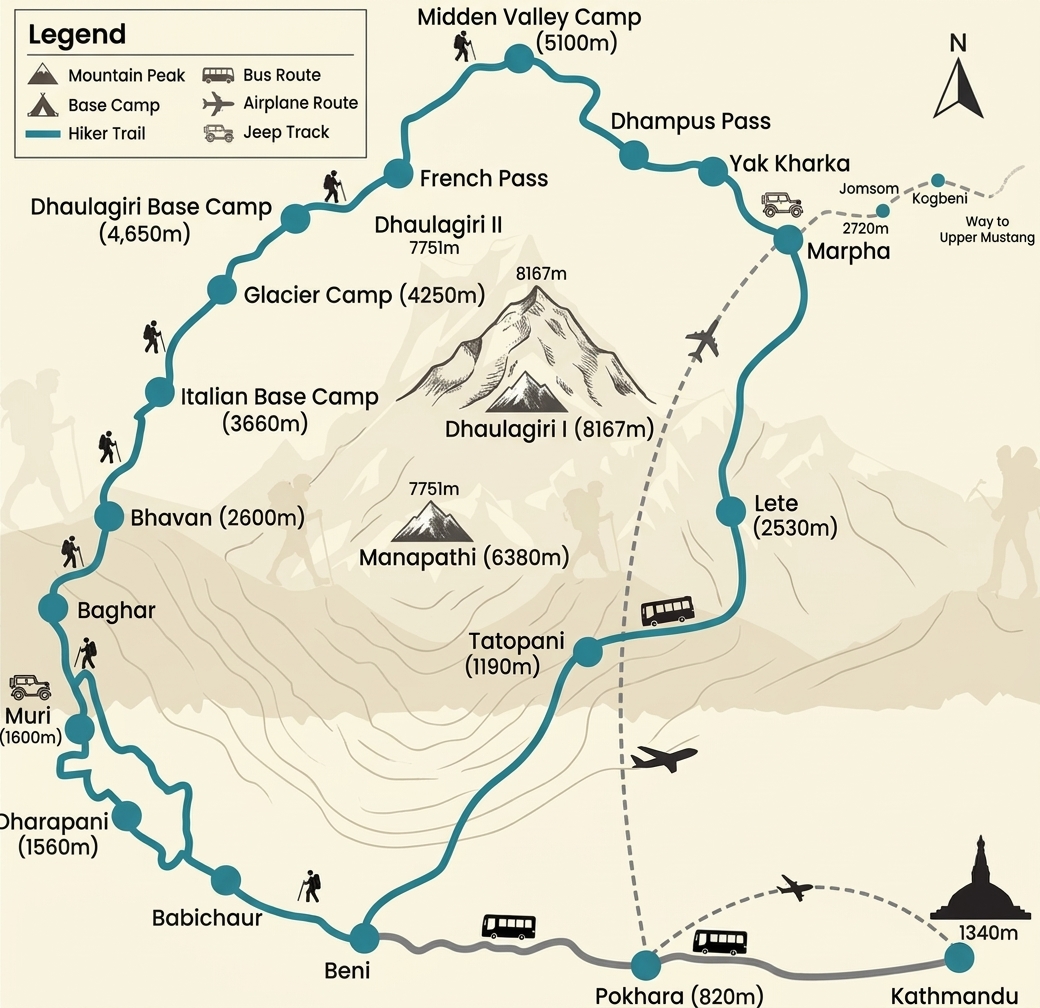
Route map image could not be loaded
Showing route for Dhaulagiri Base Camp & French Pass Trek
Route Information
Starting Point:Darbang
Ending Point:Jomsom
Highest Point:French Pass (5,360 m)
Key Locations
Darbang
Day 2
start
1,100 m
Muri
Day 3
1,850 m
Dobang
Day 5
2,520 m
Italian Base Camp
Day 6
3,660 m
Japanese Base Camp
Day 8
4,200 m
Dhaulagiri Base Camp
Day 9
4,750 m
French Pass
Day 11
landmark
5,360 m
Hidden Valley
Day 11
5,050 m
Dhampus Pass
Day 12
landmark
5,234 m
Marpha
Day 13
end
2,670 m
Frequently Asked Questions
It is the hardest trek we sell and is routinely described as one of the hardest trekking routes in Nepal. You cross French Pass at 5,360 m and Dhampus Pass at about 5,234 m within three days, sleep above 5,000 m in Hidden Valley, camp for ten nights with no lodges above 3,660 m, and spend six days with no village and no road access.
Still have questions?
Our travel experts are here to help you plan the perfect trip. Get in touch with us for personalized advice.
Reviews & Ratings
—
0 reviews
5★
0
4★
0
3★
0
2★
0
1★
0
Share Your Experience
Have you completed this trek? Help other travelers by sharing your experience.