Ten Things That Actually Matter on a Nepal Trek
Anos Tamang
Founder and trekking guide, Shamar Treks
Most trekking advice is a packing list with adjectives. This is the shorter version: the things that, in practice, separate a trek people enjoy from one they endure. They are not in order of glamour. They are in order of how often they go wrong.
1. Arrive with boots you have already walked in
This is the single most common avoidable problem on any trek in Nepal, and it is entirely self-inflicted. Boots bought in Thamel the day before departure will blister you by day three, and a blister at 4,000 m does not heal — it just gets worse every morning for a week.
Walk at least 50 km in them at home. On hills, carrying a pack. If you are renting anything in Kathmandu, rent a down jacket and a sleeping bag; never rent footwear.
2. Walk slower than feels natural on the first day high
Fit people struggle with altitude more often than unfit people, for a simple reason: they can push through the early warnings. The body adapts on a timescale you cannot negotiate with.
The rule that works is unfashionable and boring — walk at a pace where you could hold a conversation. If you cannot speak a full sentence, you are going too fast, regardless of how the legs feel.
3. Treat the acclimatisation day as the point, not the padding
Every good itinerary has one or two days where you gain no sleeping altitude. They exist because the effective way to acclimatise is to climb several hundred metres and come back down to sleep.
These are the days cheap itineraries cut to save money, and they are the days that decide whether you finish. If you are comparing two quotes and one is shorter, look at which days are missing before you look at the price.
4. Take more cash than you think, in small notes
There is no card payment on any trekking route in Nepal, and cash machines stop at the last road town — Namche in the Khumbu, Pokhara for the Annapurnas, and nowhere at all for the remote regions.
Your package covers rooms and meals. What it does not cover adds up faster than expected: charging a phone, a hot bucket of water, wifi that half works, a chocolate bar carried up 2,000 m. Prices roughly double between the trailhead and the highest lodge, for the obvious reason that everything arrived on someone's back.
Bring small denominations. A lodge at 4,800 m cannot change a 1,000-rupee note at seven in the morning.
5. Drink more than you want to
Dehydration produces a headache indistinguishable from mild altitude sickness, and at altitude you lose water simply by breathing the dry air. Three to four litres a day is normal, and you will not feel thirsty enough to drink it.
Carry a filter or purification tablets rather than buying bottled water. It is cheaper, and the plastic bottle problem on the popular trails is severe enough that several regions have banned their sale outright.
6. Poles are for going down
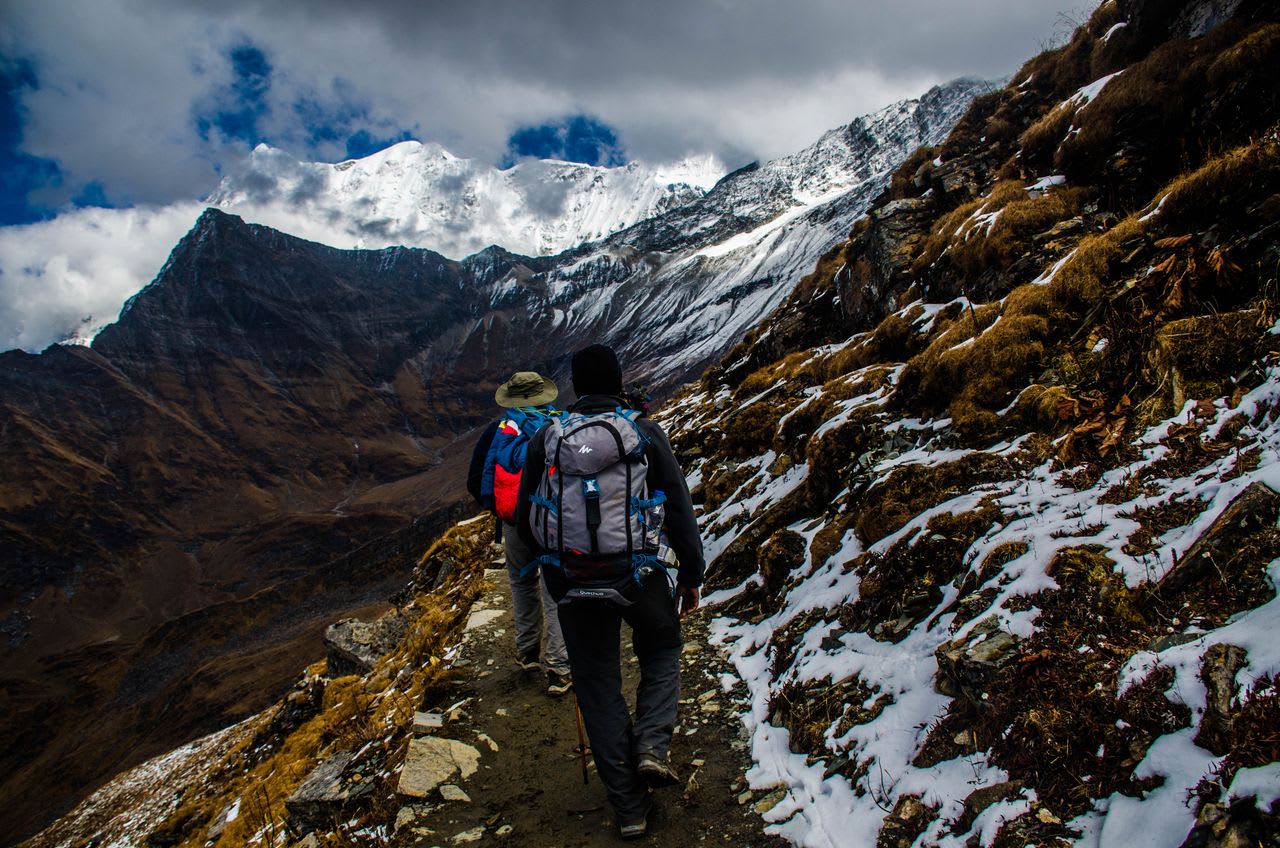
People buy trekking poles to help them climb and then wonder whether they were worth it. The climb is not the problem. The descent is — a Nepali trek can drop 1,600 m in an afternoon, almost all of it on stone steps, and your knees take every one of them.
Use two, set them longer for descent, and use them from the start rather than once it already hurts.
7. Understand that "teahouse" means someone's house
Lodges on the main routes are simple: a plywood-partitioned twin room, a shared bathroom, no heating anywhere except the dining room stove, which is lit in the evening and not before.
The room is cheap because the lodge makes its money on food. Eating elsewhere and sleeping there is considered poor form, and on quiet routes it is the difference between a lodge staying open and not.
8. Eat the dal bhat
It is rice, lentils and vegetable curry, it comes with free refills, and it is cooked constantly so it arrives hot and fresh. Everything else on a lodge menu — pizza, pasta, apple pie — is cooked occasionally from ingredients that have been up there a while.
The practical advice, which every guide in Nepal will give you: avoid meat above about 3,000 m. It was carried up unrefrigerated over several days.
9. Know the two symptoms that end a trek
Mild altitude symptoms — headache, poor sleep, low appetite, breathlessness on stairs — are common above 3,500 m and usually resolve with a rest day at the same height.
Two things are different. Ataxia, meaning loss of coordination — if you cannot walk a straight line heel to toe, that is a medical emergency. And breathlessness at rest, particularly with a wet cough. Both mean immediate descent, at night if necessary. There is no version of either that is worth pushing through, and every guide is trained to make that call.
Insurance that covers helicopter evacuation is not optional on any trek above 4,000 m. Read the exclusions, not the summary — many policies cap the altitude or exclude anything on a rope.
10. Build in a spare day
Lukla flights cancel. Mountain roads close for landslides. A pass holds snow for another day. None of these is unusual; all of them are routine.
A spare day at the end of a trip costs you one hotel night. Not having one costs you the trek, or your flight home. We build one into every itinerary for this reason and still advise against booking an international departure for the morning after you are due back.
What matters less than people think
Brand-name gear. Training at a gym rather than on hills. Carrying your own pack as a point of pride — a porter changes the trek entirely and is meaningful local employment. And the exact weight of your bag, as long as it is under about 10 kg for a daypack.
If you want the specifics for a particular route, the trip pages set out permits, altitude and what is included for each one — start with the Annapurna region if you have under a week, or the Everest region if you have a fortnight.
About Anos Tamang
Founder and trekking guide, Shamar Treks
Anos Tamang is the founder of Shamar Treks and a working trekking guide. He leads trips across Nepal's trekking regions and writes here about the practical side of them — routes, permits, seasons and the decisions that make the difference on the trail.