
Tsum Valley, Nepal
Tsum Valley Trek
Fourteen days into a valley the Tibetan tradition calls a beyul — a hidden sanctuary — where the community took a vow against killing animals and has kept it. A pilgrimage route that happens to be a trek.
Package Overview
Best Time to Visit
March to May, September to November
Guided & Permitted
Licensed, insured guide and all trekking permits included
What a beyul is, and why it changes the trek
In Tibetan Buddhist tradition a beyul is a valley concealed by Padmasambhava as a refuge — a place meant to be found in difficult times and treated as sacred ground rather than as territory. Tsum is one of them, and unlike most beyuls the designation still shapes daily life rather than surviving only in a guidebook footnote.
The clearest expression of that is a community vow against killing animals. It holds: there is no slaughter in the valley, hunting is prohibited by local agreement rather than by park regulation, and the wildlife behaves accordingly — blue sheep and Himalayan tahr are noticeably unbothered by people here in a way they are not elsewhere in Nepal.
This changes what the trek is. Tsum is not a scenery route. The mountains are good but they are not the reason anyone goes; you go for a lived Tibetan Buddhist landscape of gompas, nunneries, mani walls and caves, reached slowly on foot. If that is not what you want from fourteen days, book Langtang or the Annapurna Circuit instead — both are better mountain treks and neither pretends otherwise.
The permit rules
Tsum sits inside the restricted Manaslu region and the conditions are strict.
| Requirement | Detail |
|---|---|
| Restricted Area Permit | Tsum-specific, issued only through a registered Nepali agency |
| MCAP | Manaslu Conservation Area permit, required alongside it |
| No minimum party size | The two-person rule was dropped in March 2026 |
| Licensed guide | Mandatory as a condition of the permit |
| Checkpoints | Jagat, Lokpa, Chumling, Chhekampar and again at Mu Gompa |
| Seasonal fee | Higher September to November than the rest of the year |
All permits are included in the price and arranged by us. Until March 2026 a restricted-area permit needed two trekkers on it; that rule has been dropped, so a solo traveller can now be permitted individually. What has not changed is that the permit must come through a registered agency and a licensed guide is mandatory.
How hard is it?
Moderate, and it is worth explaining why a fourteen-day trek gets that grade rather than a higher one. The maximum altitude is about 3,700 m at Mu Gompa, which is lower than the sleeping altitude of most well-known Nepali treks and means altitude sickness is a manageable rather than dominant concern.
What makes it work is length rather than intensity. You are walking for eleven days, mostly five to seven hours, through a gorge that climbs steadily from around 900 m at Machha Khola to 3,700 m at the head of the valley — a gradual profile spread across a week, which is close to ideal.
The two genuine difficulties are the lower gorge, where the trail is narrow, exposed in places and subject to rockfall, and the sheer number of consecutive walking days. Fitness matters here more than altitude tolerance.
The three places people remember
Mu Gompa
At around 3,700 m, at the very head of the valley, an hour or so from the Tibetan border. It is the largest and remotest monastery in Tsum, set on open ground with nothing above it but grazing and the frontier ridge. Accommodation is in the monastery guesthouse, which is cold and plain and the point of the whole trek for most people who come.
Rachen Gompa
A nunnery on the valley floor near Chhekampar, and one of the largest in the Nepali Himalaya, home to a substantial community of Buddhist nuns. The interior murals are the finest in the valley. It is a functioning religious institution, so photography inside is by permission and often refused — ask, and accept the answer.
Piren Phu
A cave associated with Milarepa, the eleventh-century yogi and poet who is among the most significant figures in Tibetan Buddhism and who is said to have meditated here. It is a short detour near Chhekampar, with rock carvings and prayer flags, and it is a place of active pilgrimage rather than a monument.
Behaving well in a valley like this
We would rather set this out than have a client get it wrong.
- Walk clockwise around mani walls, chortens and stupas — left shoulder to the structure. This is not decoration; it is the correct way to pass.
- Ask before photographing people, interiors and ceremonies. In the nunneries the answer is often no.
- Do not bring meat into the valley or ask for it. The vow against killing is the defining fact of the place and there is no meat to be had in any case.
- Remove shoes entering a gompa, and do not point your feet at an altar or a person.
- Give to the monastery, not to children. Handing sweets or money to children on the trail is well-meant and does real damage; a donation at the gompa reaches the community properly.
Your guide will prompt you on all of this. None of it is difficult and it is the difference between being a visitor and being a problem.
Adding the Manaslu Circuit
Tsum branches off the Manaslu Circuit trail at Lokpa, which means the two combine without backtracking. The joint trip runs to around eighteen to twenty days and adds the Larkya La at 5,106 m — a serious pass and a completely different kind of day from anything in Tsum.
Whether to combine them is a real decision rather than an upsell. Tsum alone is a contemplative trek at modest altitude; adding Manaslu turns it into a high-pass expedition with a cultural first half. They are not the same holiday. We are happy to talk it through honestly before you commit.
Accommodation and food
Simple lodges and homestays throughout, with the monastery guesthouse at Mu Gompa. Rooms are plain, unheated apart from the dining stove, and bathrooms are shared or outside. Electricity is solar and unreliable above Chumling.
Food is vegetarian by circumstance rather than by menu policy — dal bhat, potatoes, noodles, eggs, seasonal greens, and a great deal of tea. If you are a committed carnivore, fourteen days here will test you more than the walking will.
Season
September to November gives the most settled weather and the valley at its most active, with festivals in the gompas through the autumn. March to May is warm lower down, with rhododendron in the gorge and the upper valley still cold.
Winter empties the upper valley — Mu Gompa is barely habitable and many families move down. The monsoon is genuinely dangerous in the lower gorge because of landslides on the Machha Khola section, and we do not run it.
Where this trek goes
- Tsum Valley — A sacred Himalayan valley closed to outsiders until 2008, where killing animals has been forbidden by community agreement for over a century
- Kathmandu Valley — Seven UNESCO Monument Zones within an hour of each other
Related activities: Trekking in Nepal, Cultural & Heritage Tours.
Or compare every trip we run: all trekking and tour packages.
Trip Highlights
Mu Gompa (about 3,700 m) at the head of the valley, an hour from the Tibetan border
Rachen Gompa, one of the largest nunneries in the Nepali Himalaya
Piren Phu, the cave associated with the yogi Milarepa
A valley that holds a community-wide vow against killing animals
Restricted-area permits keep visitor numbers genuinely low
Links directly to the Manaslu Circuit if you want to add it
Live Weather
Detailed Itinerary
1
Day 1: Kathmandu to Machha Khola (900 m)
Eight to nine hours by private jeep west to Dhading Besi and then north up the Budhi Gandaki on progressively rougher road. A long, dusty day that gets you to the trailhead so the walking can start properly tomorrow. Overnight in a simple lodge beside the river.
2
Day 2: Machha Khola to Jagat (1,340 m)
Six to seven hours up the Budhi Gandaki gorge, crossing and re-crossing on suspension bridges, past the hot springs at Tatopani. The trail is narrow in places and carved into the hillside above the river. Jagat is a flagstoned village and the first permit checkpoint — this is where the restricted-area paperwork is registered.
3
Day 3: Jagat to Lokpa (2,240 m)
Six to seven hours continuing up the gorge to Philim, then climbing steeply away from the main valley at the junction where the Tsum trail branches from the Manaslu Circuit. Lokpa is the first village of the Tsum Valley proper — a handful of houses on a shelf, with the character of the trek changing as soon as you turn the corner.
4
Day 4: Lokpa to Chumling (2,386 m)
Five to six hours on a trail that drops to the river and climbs again through pine forest, with the first views of Ganesh Himal opening up ahead. Chumling is a proper Tsum village with a gompa, stone houses and mani walls along the path. The Tibetan character of the valley is unmistakable from here on.
5
Day 5: Chumling to Chhekampar (3,010 m)
Five to six hours climbing into the upper valley as the gorge finally opens into broad farmland. Ganesh Himal fills the view behind you for much of the morning. Chhekampar sits on the valley floor among barley fields and is the base for the next day's exploring. First night above 3,000 m.
6
Day 6: Chhekampar: Rachen Gompa and Piren Phu
A day without a pack, which doubles as acclimatisation. Rachen Gompa is one of the largest nunneries in the Nepali Himalaya, with the best murals in the valley — photography inside is by permission and often refused. Piren Phu, the cave associated with the yogi Milarepa, is a short walk further with rock carvings and prayer flags. Three to four hours of easy walking, and the cultural heart of the trek.
7
Day 7: Chhekampar to Nile (3,361 m)
Four to five hours up the widening valley past Lamagaon and Burji, through increasingly open, dry, Tibetan-looking country with long mani walls beside the trail. Nile is the last permanent settlement before the valley head. Short and deliberate, so the altitude is gained slowly.
8
Day 8: Nile to Mu Gompa (about 3,700 m)
Three to four hours to the head of the valley and the largest monastery in Tsum, set on open ground with nothing above it but grazing and the Tibetan frontier ridge an hour or so beyond. You sleep in the monastery guesthouse: cold, plain, and for most people who come here the point of the entire trek. Afternoon to walk up towards the border viewpoint if you are moving well.
9
Day 9: Mu Gompa to Chhekampar
Six to seven hours back down the valley, which walks entirely differently in this direction with the Ganesh Himal ahead of you most of the way. We stop at Dephyudonma Gompa on the descent if time and weather allow — an older and smaller monastery on the hillside that most groups skip.
10
Day 10: Chhekampar to Chumling
Five to six hours retracing the upper valley, with time in the villages you moved through quickly on the way up. This is the day people take most of their photographs, having finally understood what they are looking at.
11
Day 11: Chumling to Philim (1,570 m)
Six to seven hours dropping back out of the Tsum Valley to the junction at Lokpa and on to Philim on the Manaslu Circuit trail. A long descent and a noticeable return to warmth, greenery and other trekkers.
12
Day 12: Philim to Machha Khola
Six to seven hours back down the Budhi Gandaki gorge through Jagat and Tatopani — the same narrow, exposed, spectacular river trail, walked in the other direction and with the season's heat now at the bottom of the valley.
13
Day 13: Machha Khola to Kathmandu
Eight to nine hours by jeep, following the Budhi Gandaki down to Arughat and Dhading Besi before joining the Prithvi highway for the last stretch into Kathmandu. The first half is rough, dusty and slow; the second half is sealed road and feels like another country. Expect to arrive in the evening, and expect the contrast between a monastery guesthouse at 3,700 m and a Thamel hotel to be more disorienting than you are braced for. Drop-off at your hotel.
14
Day 14: Kathmandu — spare day
Held in reserve. The Machha Khola road is prone to landslide closures and a lost half-day on the way out is common enough that we plan for it rather than gamble your flight home on it. If the road behaves, it is a free day in Kathmandu and we can arrange a guided visit to the valley's Buddhist sites, which will make a good deal more sense to you after Tsum than it would have done a fortnight earlier.
Cost Details
What's Included
- Private jeep, Kathmandu to Machha Khola and return
- Tsum Valley Restricted Area Permit
- Manaslu Conservation Area permit and TIMS card
- All accommodation on trek in lodges, homestays and the Mu Gompa guesthouse
- Breakfast, lunch and dinner throughout the trek
- Licensed, insured English-speaking guide familiar with the valley's customs
- Guide wages, insurance, equipment, food and accommodation
- First aid kit and pulse oximeter carried by the guide
- One spare night in Kathmandu against road closures
- Government taxes and company service charge
What's Not Included
- International flights and Nepal visa
- Travel insurance — must cover helicopter evacuation
- Accommodation and meals in Kathmandu beyond the spare night
- Porter — strongly recommended on a fourteen-day trek, available at a daily rate
- Hot water, charging and bottled drinks in the upper valley
- Monastery donations and entry offerings
- Personal trekking equipment and a sleeping bag rated to -10°C
- Manaslu Circuit extension, quoted separately
- Tips for guide and porter
- Any cost arising from early descent, evacuation or road closure
Essential Information
- Maximum altitude: 3,700 m
- Trip duration: 14 days
- Difficulty: moderate
- Best season: March to May, September to November
- Group size: 2 to 10 trekkers
- Permits: Tsum Valley Restricted Area Permit — issued only through a registered agency; Manaslu Conservation Area permit; TIMS card — all included and arranged by us
- Accommodation: Lodges, homestays and the Mu Gompa monastery guesthouse
- Guide: licensed and insured, English speaking
- Weather reference point: Mu Gompa
Important Cost Information
Payment Terms:
- • 25% deposit required to confirm booking
- • Balance payment due 30 days before departure
- • Full refund if cancelled 45+ days before
Fixed Departure Dates
Choose from our scheduled group departures with guaranteed departures.
Route Map
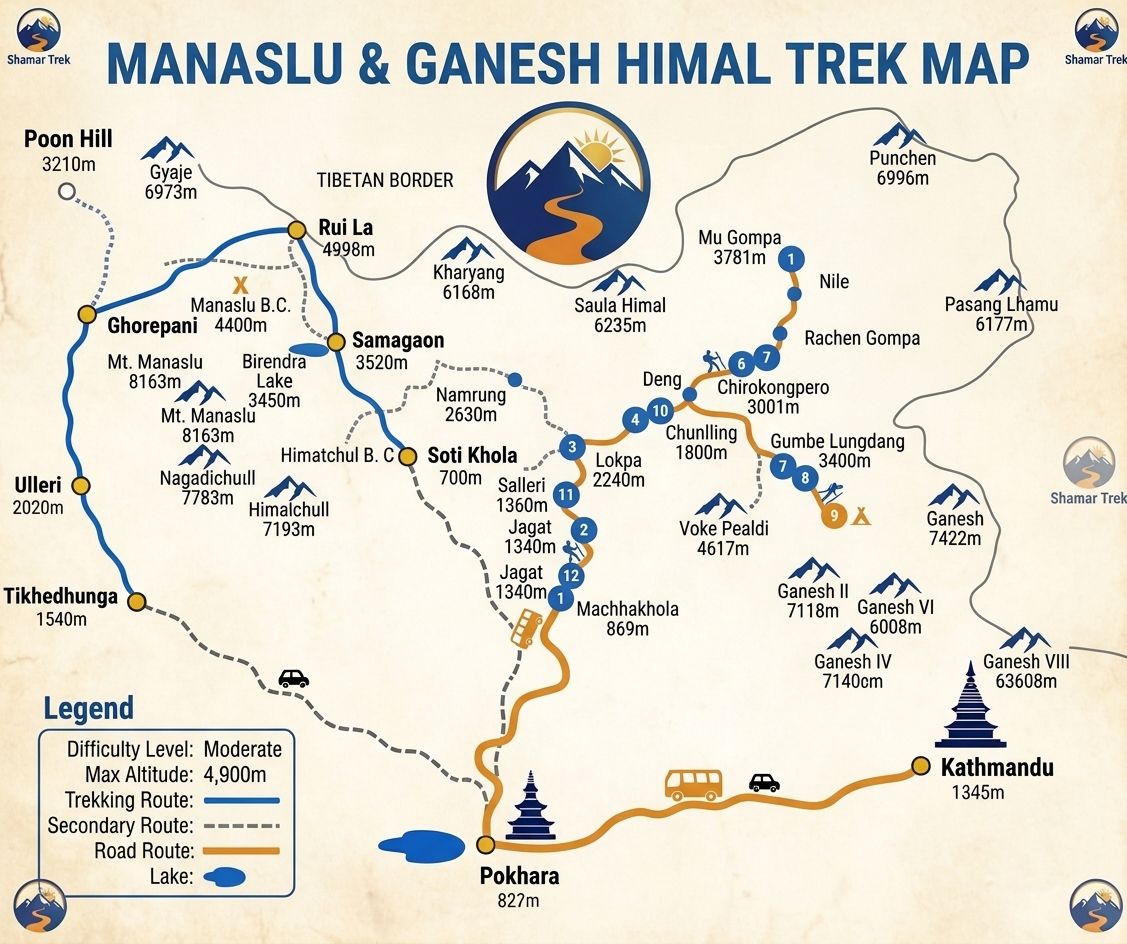
Route map image could not be loaded
Showing route for Tsum Valley Trek
Route Information
Starting Point:Machha Khola
Ending Point:Machha Khola
Highest Point:Mu Gompa (3,700 m)
Key Locations
Machha Khola
Day 1
start
900 m
Jagat
Day 2
1,340 m
Lokpa
Day 3
2,240 m
Chumling
Day 4
2,386 m
Chhekampar
Day 5
3,010 m
Nile
Day 7
3,361 m
Mu Gompa
Day 8
3,700 m
Frequently Asked Questions
A beyul is a valley that Tibetan Buddhist tradition holds was concealed by Padmasambhava as a sacred refuge. Tsum is one, and unusually the designation still governs daily life — most visibly through a community-wide vow against killing animals, which is observed in practice and is the defining fact of the valley.
Still have questions?
Our travel experts are here to help you plan the perfect trip. Get in touch with us for personalized advice.
Reviews & Ratings
—
0 reviews
5★
0
4★
0
3★
0
2★
0
1★
0
Share Your Experience
Have you completed this trek? Help other travelers by sharing your experience.