
Everest Region (Khumbu), Nepal
Lobuche Peak with Everest Base Camp
Fifteen days to Everest Base Camp and up Lobuche East at 6,119 m — the peak that rises straight off the Base Camp trail, and the most sustained climbing of the three Khumbu trekking peaks.
Package Overview
Best Time to Visit
April to May, October to November
Guided & Permitted
Licensed, insured guide and all trekking permits included
The peak you walk past on the way to Base Camp
Everyone who treks to Everest Base Camp sleeps at the village of Lobuche, at 4,940 m, with a mountain directly above them. Most of them never learn its name. Lobuche East is 6,119 m and it is the only one of the three Khumbu trekking peaks that requires no separate approach valley at all — you turn off the main trail and start climbing.
That geography is the whole appeal. It makes this the shortest 6,000 m climbing itinerary we run at fifteen days, and it means the acclimatisation is done on the finest trekking trail in the world rather than on an approach march.
It is the hardest summit day of the three
This needs stating clearly, because the shorter itinerary implies an easier trip and the opposite is true of the climbing.
Island Peak has one crux — the headwall — with easier ground either side. Mera has a long easy snow slope. Lobuche East is sustained: a rock section low down, then a long steep snow and ice slope that keeps its angle for hours, with fixed rope on the steepest pitches and an exposed final ridge. There is less easy ground to recover on.
| Lobuche East | Island Peak | |
|---|---|---|
| Height | 6,119 m | 6,189 m |
| Itinerary | 15 days | 15 days |
| Summit day | 8–12 hrs, sustained angle | 10–14 hrs, one crux |
| Technical ground | Rock step, long ice slope, ridge | Glacier, headwall, ridge |
| Crevasse risk | Lower | Higher — a real glacier crossing |
| Best for | Climbers wanting more climbing | A first 6,000 m summit |
If this would be your first time on a rope, Island Peak is the better introduction. If you have climbed before and want a summit day that feels like mountaineering rather than a graded route with one hard bit, this is the one.
Two names, and which mountain you are climbing
Worth clearing up, because operators are careless with it. The Lobuche massif has two summits: Lobuche East at 6,119 m, which is the NMA trekking peak and what this trip climbs, and Lobuche West at 6,145 m, which is an expedition peak requiring a different permit and a considerably harder climb.
If a quote says only "Lobuche Peak" without specifying East, ask. The two are not interchangeable and the permits are not either.
Why Base Camp and Kala Patthar come first
The same logic as our other climbing trips, and on this itinerary it is especially efficient. Lobuche village sits on the Base Camp trail, so walking to Everest Base Camp (5,364 m) and climbing Kala Patthar (5,545 m) costs you no detour whatsoever — you pass back through Lobuche on the way down and start the climb from there.
By the time you reach high camp you will have slept above 5,000 m twice and been above 5,500 m once. That is a far better preparation for a 6,119 m summit than any amount of training at sea level.
Summit day
From a tented high camp at around 5,400 m, and it is a genuine mountaineering day of eight to twelve hours.
The lower section is rock and moraine in the dark, including a scrambly step where you will use your hands. Then the glacier and the long snow and ice slope, roped, with fixed line on the steeper pitches — this is the sustained part and it is where fitness tells. The final ridge is narrow and exposed, and the summit gives Everest, Lhotse, Nuptse, Ama Dablam and Cho Oyu at once.
The descent involves abseiling the steep sections, which is why the skills day covers it properly. Coming down tired on a rope you do not trust is the situation the training exists to prevent.
What we provide, and the one thing to arrive with
We supply all group hardware — ropes, ice screws, snow bars, fixed line — and will provide harness, helmet, jumar, carabiners, ice axe and crampons if you ask at booking.
Arrive with mountaineering boots that fit and that you have walked in. This is the single most common cause of a failed summit attempt on Lobuche East, ahead of weather and ahead of fitness. A rented boot that rubs at 5,400 m becomes a decision at 5,800 m. Down jackets and sleeping bags rent perfectly well in Kathmandu; boots are worth owning.
On guarantees
There are none, and we would treat any as a warning sign. Lobuche East is affected by conditions on the ice, the state of the fixed ropes, the weather window and how you have acclimatised. We include a contingency day so that one bad morning does not end the attempt, we guide one to one on summit day, and our guides turn clients around with the company's full support when that is the right call.
What you are buying is the best possible attempt, competently supported. Anyone selling you a summit is selling you something they cannot deliver.
Permits
- NMA climbing permit for Lobuche East — seasonal fee, and specific to East rather than West
- Sagarmatha National Park entry permit
- Khumbu Pasang Lhamu rural municipality fee
- TIMS card
All included. As with every NMA peak, solo climbing is not permitted and a certified climbing guide is a condition of the permit.
What the fifteen days do and do not include
Lobuche East is also sold in twelve or thirteen days, by skipping Everest Base Camp and Kala Patthar and going more or less straight up the Khumbu. We do not sell that version, for one reason: the peak is 6,119 m and those itineraries have you attempting it having never been above about 5,000 m. The summit slope is sustained, so altitude does not merely make it unpleasant — it makes it slow, and being slow on that slope is what turns a party around at four in the afternoon instead of eleven in the morning.
This itinerary keeps that defence intact. Both acclimatisation days are here, at Namche and Dingboche, and you still walk to Base Camp at 5,364 m and climb Kala Patthar at 5,545 m before going anywhere near the mountain. You arrive at high camp having already stood higher than the summit of many of the peaks you can see.
What the shorter version removes is the Kathmandu arrival day, which we handle with an evening kit check at Phakding instead, the standalone skills day, which becomes the afternoon at high camp, and the summit contingency day. That last one is the real trade and we will not pretend otherwise: on the eighteen-day version, a bad-weather morning meant trying again tomorrow. Here it means not summiting. If a guaranteed second attempt matters to you, ask us for the longer itinerary — it still exists and we will happily run it.
Season
April to May and October to November. Spring tends to give more consolidated snow on the upper slope; autumn gives colder, clearer summit days and better views. We do not run it outside those windows.
One thing particular to this peak: because it is climbed by relatively few parties compared with Island Peak, the fixed ropes on the steep pitches are not maintained by a steady stream of traffic. Early in a season they may need re-rigging, which your guide will do, and late in one they may be in poor condition. It is a reason to prefer the middle weeks of either window rather than the edges.
Where this trek goes
- Kathmandu Valley — Seven UNESCO Monument Zones within an hour of each other
Related activities: Peak Climbing in Nepal, Trekking in Nepal.
Or compare every trip we run: all trekking and tour packages.
Trip Highlights
Lobuche East (6,119 m) — the steepest sustained climbing of the Khumbu trekking peaks
Everest, Lhotse, Nuptse, Ama Dablam and Cho Oyu from the summit
Everest Base Camp (5,364 m) and Kala Patthar (5,545 m) first, as acclimatisation
The peak rises directly off the Base Camp trail — no separate approach valley
The shortest of our three 6,000 m peak itineraries
A dedicated skills day before the climb
Live Weather
Detailed Itinerary
1
Day 1: Fly to Lukla (2,840 m), trek to Phakding (2,610 m)
An early flight into Lukla — or a pre-dawn drive to Ramechhap and a flight from there in peak season — then three to four hours down the Dudh Koshi. Short and mostly downhill, which is what the first afternoon should be after a thirty-minute flight that gains most of the height for you. Climbing kit is checked tonight, not in Kathmandu.
2
Day 2: Phakding to Namche Bazaar (3,440 m)
Five to six hours up the valley on high suspension bridges, into Sagarmatha National Park at Monjo, then the steep pull to Namche. Everest shows itself from a bend partway up if the cloud allows. Namche is the last place with gear shops, bank machines and anything resembling a choice of food.
3
Day 3: Namche Bazaar — acclimatisation day
An active day, not a rest day. Up to the Everest View Hotel at 3,880 m or across to Khumjung and back, climbing several hundred metres and returning to sleep low. Along with the Dingboche day this survived the shortening untouched, because these are the two days the summit actually rests on.
4
Day 4: Namche to Tengboche (3,860 m)
Five to six hours down to Phunki Thenga and up through rhododendron forest to the monastery, which sits on a shelf looking straight at Ama Dablam with Everest and Lhotse behind it. Worth timing the afternoon to catch the prayer ceremony.
5
Day 5: Tengboche to Dingboche (4,410 m)
Five to six hours through Pangboche and up into the Imja valley, with the treeline falling away behind you. The air changes character on this day more than on any other, and the last twenty minutes into Dingboche are slower than the map suggests.
6
Day 6: Dingboche — acclimatisation day
Nangkartshang Peak above the village, around 5,080 m, four to five hours up and back, sleeping again at 4,410 m. For most people this is the first time above 5,000 m, and how you feel on it tells your guide more about the summit than anything you can put on a booking form.
7
Day 7: Dingboche to Lobuche (4,940 m)
Five to six hours up the valley past Thukla, where the ridge carries memorial cairns for climbers lost on Everest. Lobuche itself is a handful of lodges on the moraine of the Khumbu Glacier, and from here the peak you have come to climb is directly above you.
8
Day 8: Lobuche to Everest Base Camp (5,364 m), night at Gorak Shep (5,170 m)
Six to seven hours in total: along the glacier’s lateral moraine to Gorak Shep, then out to Base Camp and back. What you see there is the Khumbu Icefall, not Everest, which is hidden behind Nuptse. In spring the moraine is covered in expedition tents.
9
Day 9: Kala Patthar (5,545 m), descend to Lobuche (4,940 m)
Before dawn up Kala Patthar — the highest you go on foot before the climb, and the single best view on this side of Khumbu — then back down to Lobuche for the night. This is the point of doing Base Camp before the peak rather than after it: you arrive at the mountain having already been to 5,545 m.
10
Day 10: Lobuche to Lobuche Peak High Camp (about 5,400 m), skills afternoon
Three to four hours up moraine and rock to the high camp on a shoulder below the peak. The afternoon is the skills session — crampons, harness, jumar, abseil and fixed-rope work on real ground rather than a slope near a lodge. On the eighteen-day version this was a separate day; here it shares the day with the walk up, which works because the walk is short.
11
Day 11: Summit Lobuche East (6,119 m), descend to Lobuche
Away in the dark for eight to twelve hours round trip. A rock step low down, then the long ice slope that gives this peak its reputation — sustained at 40 to 45 degrees with fixed rope where it steepens — and a corniced summit ridge that is walked carefully and roped throughout. The true summit is the one at 6,119 m, not the nearer false top. Down to Lobuche to sleep.
12
Day 12: Lobuche to Tengboche (3,860 m)
Six to seven hours and a descent of nearly 1,100 m, back down the valley past Thukla and Pangboche. A long day that gets easier with every hundred metres, which is the opposite of how the walk up felt. Trees again by the end of it.
13
Day 13: Tengboche to Namche Bazaar (3,440 m)
Four to five hours, dropping to Phunki Thenga and climbing the far side before the traverse back into Namche. Shorter than yesterday and welcome for it. Hot shower, a bakery and the first real menu in a fortnight.
14
Day 14: Namche Bazaar to Lukla (2,840 m)
Six to seven hours retracing the first two days in one, down the steep hill out of Namche and along the Dudh Koshi, with the last climb into Lukla as a final insult. Last night on the trail.
15
Day 15: Fly Lukla to Kathmandu
A morning flight, weather permitting — the standing caveat on every Khumbu itinerary. Flights run early because wind builds through the day. If Lukla closes we hold and talk through a helicopter transfer at cost. There is no spare day in this version, so leave slack before your onward flight.
Cost Details
What's Included
- Return flights, Kathmandu to Lukla
- NMA climbing permit for Lobuche East
- Sagarmatha National Park permit, municipality fee and TIMS card
- All lodge accommodation on trek, twin share
- Tented high camp with full crew and cook
- Breakfast, lunch and dinner throughout
- Certified climbing guide, one to one on summit day
- A dedicated climbing and abseil skills day at high camp
- All group climbing equipment: ropes, ice screws, snow bars, fixed line
- Personal climbing hardware on request: harness, helmet, jumar, ice axe, crampons
- Crew wages, insurance, equipment, food and accommodation
- First aid kit, pulse oximeter and emergency oxygen
- One contingency day for the summit and one spare day in Kathmandu
- Government taxes and company service charge
What's Not Included
- International flights and Nepal visa
- Travel insurance — must cover peak climbing to 6,500 m and helicopter evacuation
- Accommodation and meals in Kathmandu beyond arrival night
- Mountaineering boots, down jacket and sleeping bag — boots best owned rather than rented
- Hot showers, wifi, charging and bottled drinks in lodges
- Summit bonus for the climbing guide, which is customary
- Tips for guide, cook and porters
- Any cost arising from an aborted summit attempt, early descent or evacuation
Essential Information
- Maximum altitude: 6,119 m
- Trip duration: 15 days
- Difficulty: expert
- Best season: April to May, October to November
- Group size: 2 to 8 trekkers
- Permits: NMA climbing permit for Lobuche East; Sagarmatha National Park entry permit; Khumbu Pasang Lhamu rural municipality fee; TIMS card — all included and arranged by us
- Accommodation: Lodges on trek, tented high camp on the peak
- Guide: licensed and insured, English speaking
- Weather reference point: Lobuche
Important Cost Information
Payment Terms:
- • 25% deposit required to confirm booking
- • Balance payment due 30 days before departure
- • Full refund if cancelled 45+ days before
Fixed Departure Dates
Choose from our scheduled group departures with guaranteed departures.
Route Map
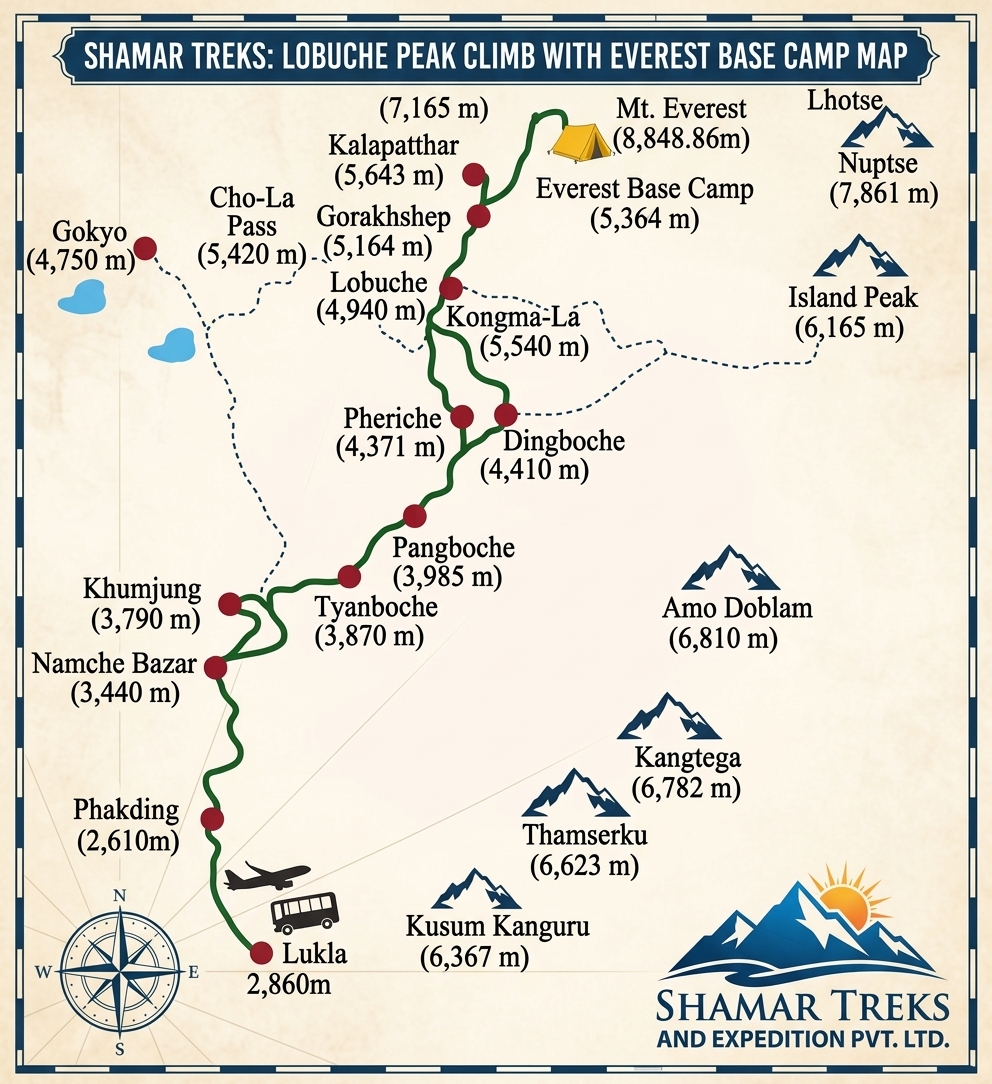
Route map image could not be loaded
Showing route for Lobuche Peak with Everest Base Camp
Route Information
Starting Point:Lukla
Ending Point:Lukla
Highest Point:Lobuche East (6,119 m)
Key Locations
Lukla
Day 1
start
2,840 m
Namche Bazaar
Day 2
3,440 m
Tengboche
Day 4
3,860 m
Dingboche
Day 5
4,410 m
Lobuche
Day 7
4,940 m
Everest Base Camp
Day 8
landmark
5,364 m
Kala Patthar
Day 9
landmark
5,545 m
Lobuche High Camp
Day 10
5,400 m
Lobuche East summit
Day 11
landmark
6,119 m
Frequently Asked Questions
Lobuche East is 6,119 m, and that is the peak this trip climbs. High camp is at around 5,400 m. On the way in you also reach Everest Base Camp at 5,364 m and Kala Patthar at 5,545 m.
Still have questions?
Our travel experts are here to help you plan the perfect trip. Get in touch with us for personalized advice.
Reviews & Ratings
—
0 reviews
5★
0
4★
0
3★
0
2★
0
1★
0
Share Your Experience
Have you completed this trek? Help other travelers by sharing your experience.