
Annapurna Region, Nepal
Ghorepani Poon Hill Trek
Four days from Pokhara to a sunrise over Dhaulagiri and Annapurna, through rhododendron forest and Gurung villages — the best short trek in Nepal for a first visit.
Package Overview
Best Time to Visit
October to April
Guided & Permitted
Licensed, insured guide and all trekking permits included
What you are actually getting in four days
Poon Hill is the most walked trail in Nepal, and it is worth being straightforward about why. It is not remote, it is not quiet, and on a clear October morning there may be two hundred people on the viewpoint with you.
What it is, uniquely, is the only trek in Nepal that puts you in front of two separate 8,000 m massifs — Dhaulagiri and Annapurna I — at sunrise, inside four days, with no altitude risk and no internal flight to be cancelled. Nothing else in the country combines those four things.
If you have a week in Nepal and want one trek, this is a better use of it than a compressed version of something bigger.
The honest difficulty
This trek is graded easy, and people still find day one harder than they expected. The reason is the stone staircase from Tikhedhunga to Ulleri — roughly 3,000 steps, gaining around 500 m in a little over an hour of relentless climbing.
It is not dangerous and it is not technical. It is simply a long staircase, and it is the one part of this trek people remember physically. Trekking poles help more here than anywhere else on the route, particularly on the descents on days three and four, which are harder on knees than the climbs are on lungs.
| Day | Walking | Height gained | The hard part |
|---|---|---|---|
| 1 | 4–5 hrs | ~1,100 m | The Ulleri staircase |
| 2 | 3–4 hrs | ~900 m | Steady forest climb, no sting |
| 3 | 6–7 hrs | Up then down | Longest day — Poon Hill at dawn, then a full day's walk |
| 4 | 3–4 hrs | Descent | Knees |
The maximum altitude is 3,210 m, and that matters
Poon Hill tops out at 3,210 m and you sleep no higher than Ghorepani at around 2,870 m. Acute mountain sickness at these heights is uncommon and usually mild.
This is the main practical reason to choose this trek over anything in the Everest or upper Annapurna regions if your time is limited: there is no acclimatisation schedule to respect, so four days is genuinely four days rather than a compressed version of something that needs eight.
When to go, and what changes
October and November give the clearest air of the year. The monsoon has washed the haze out and Dhaulagiri is sharp from the viewpoint. It is also the busiest period.
Late March into April is the other reason to come. The forest between Banthanti and Ghorepani is rhododendron — Nepal's national flower — and in a good spring whole hillsides turn red and pink. The mountain views are hazier than autumn, and most people who have seen the forest in bloom consider it a fair trade.
December and January are cold at Ghorepani, occasionally with snow on the viewpoint, and very much quieter. The air is often at its clearest of all.
Monsoon is the one period to avoid. The viewpoint is in cloud, the stone steps are slick, and leeches are active in the forest sections.
The crowd, and how to be ahead of it
Nobody books this trek expecting solitude, but almost everybody underestimates the specific pinch point: the last fifteen minutes of trail below the Poon Hill platform, between about 5.10 and 5.40 am, when four or five lodges' worth of people arrive at once.
The climb from Ghorepani takes 45 minutes to an hour. Sunrise light starts well before the sun clears the ridge. We leave at 4.30 rather than 5.00 — half an hour earlier than most groups — which costs you half an hour of sleep and buys a position on the platform rather than a place on the steps below it.
Two other things worth knowing. The tower platform is not the only vantage point; the ground thirty metres north-west of it is lower, emptier and has the same skyline. And if the morning is cloudy, the crowd thins dramatically within ten minutes of the cloud settling — which is often precisely when it breaks.
Why quotes for this trek vary so widely
You will see this itinerary advertised anywhere from under 200 US dollars to over 600, and the trek is the same trek. The difference is almost entirely in what has been left out of the cheap quote.
| Usually missing from a budget quote | Where it lands |
|---|---|
| Lunches and dinners on trek | Paid at each lodge, the largest hidden cost |
| ACAP permit and TIMS card | Paid in Pokhara before you start |
| Private transport to the trailhead | Replaced with a shared local bus |
| Guide insurance | Not paid at all, which is the real problem |
| A licensed guide rather than a porter-guide | Cheaper, and not what the regulations intend |
Our price includes all three meals a day, both permits, private vehicles at both ends, and a licensed guide who is insured. When you compare us against a cheaper quote, the only useful question is which of the rows above that quote covers — not what the headline number is.
If you want the same view with fewer people
We will say this before you book rather than after. Two alternatives give comparable views with a fraction of the traffic:
Khopra Danda branches from the same trail, sits higher at 3,660 m, faces Dhaulagiri directly, and uses community-run lodges. It needs seven days.
Mohare Danda is a community eco-trek on the ridge opposite, built and run by local villages with income going into local schools. Four days, and you may not see another foreign trekker.
Poon Hill wins on convenience, lodge comfort and the fact that the trail is superbly maintained. If those matter to you, it remains the right choice.
Combining it with Annapurna Base Camp
This trek and the Annapurna Sanctuary share a trail as far as Chhomrong. If you have a fortnight rather than a week, running them together is substantially better than either alone — you get the sunrise and the amphitheatre, and the acclimatisation from the Poon Hill section sets you up for the higher ground. Ask us and we will price the combination.
Permits
An ACAP entry permit and a TIMS card, both included and arranged by us in Pokhara. You need your passport and passport photographs. There is a checkpoint at Birethanti on day one and another at Ghandruk.
Lodges on this route
Better than you will find higher up in Nepal. Ghorepani in particular has lodges with heated dining rooms, hot showers, attached bathrooms in some rooms, and menus that run well beyond dal bhat. This is one of the few treks in the country where the accommodation is a comfort rather than a compromise, which is part of why it suits a first visit.
Where this trek goes
- Pokhara — A lakeside town at 820 m with the Annapurnas 30 km away
Related activities: Trekking in Nepal, Cultural & Heritage Tours.
Or compare every trip we run: all trekking and tour packages.
Trip Highlights
Sunrise from Poon Hill (3,210 m) over two separate 8,000 m massifs
Rhododendron forest at its best from late March into April
Ghandruk, one of the largest and best-preserved Gurung villages
No altitude risk worth planning around
Four days total, including transport from Pokhara
Live Weather
Detailed Itinerary
1
Day 1: Pokhara to Ulleri (1,960 m)
An hour and a half by road to Nayapul, then a gentle walk along the Modi Khola to Tikhedhunga for lunch. The afternoon is the climb everyone talks about: roughly 3,000 stone steps to Ulleri, around 500 m of ascent in a little over an hour. Take it slowly; there is no prize for speed and the village at the top is pleasant.
2
Day 2: Ulleri to Ghorepani (2,874 m)
Three to four hours, and the best forest walking of the trek. The trail climbs steadily through oak and rhododendron, past Banthanti and Nangethanti. In late March and April this section is spectacular. A short day by design, arriving early enough to rest before the dawn start.
3
Day 3: Poon Hill (3,210 m) at sunrise, then Tadapani (2,630 m)
Up at 4:30 for the 45-minute climb in the dark to the viewpoint. Dhaulagiri, Annapurna South, Machhapuchhre and Nilgiri light up in sequence. Back to Ghorepani for breakfast, then the longest day of the trek — five to six hours contouring through forest to Tadapani, with Annapurna South in view for much of it.
4
Day 4: Tadapani to Ghandruk (1,940 m), drive to Pokhara
Two to three hours downhill through rhododendron forest to Ghandruk, one of the largest Gurung villages in Nepal and worth an hour before you leave — stone houses, slate roofs, and a small Gurung museum. Then the drive back to Pokhara, arriving mid to late afternoon.
Cost Details
What's Included
- Private transport, Pokhara to Nayapul and Ghandruk to Pokhara
- All lodge accommodation on trek, twin share
- Breakfast, lunch and dinner throughout the trek
- Licensed, insured English-speaking trekking guide
- ACAP entry permit and TIMS card
- Guide wages, insurance, equipment, food and accommodation
- First aid kit carried by the guide
- Government taxes and company service charge
What's Not Included
- International flights and Nepal visa
- Travel insurance
- Accommodation and meals in Pokhara
- Porter — available on request
- Hot showers, wifi, battery charging and bottled drinks in lodges
- Personal trekking equipment and sleeping bag
- Tips for guide and porter
- Entrance fee to the Gurung museum in Ghandruk
Essential Information
- Maximum altitude: 3,210 m
- Trip duration: 4 days
- Difficulty: easy
- Best season: October to April
- Group size: 1 to 14 trekkers
- Permits: ACAP entry permit; TIMS card — all included and arranged by us
- Accommodation: Lodges on trek, twin share
- Guide: licensed and insured, English speaking
- Weather reference point: Ghorepani
Important Cost Information
Payment Terms:
- • 25% deposit required to confirm booking
- • Balance payment due 30 days before departure
- • Full refund if cancelled 45+ days before
Fixed Departure Dates
Choose from our scheduled group departures with guaranteed departures.
Route Map
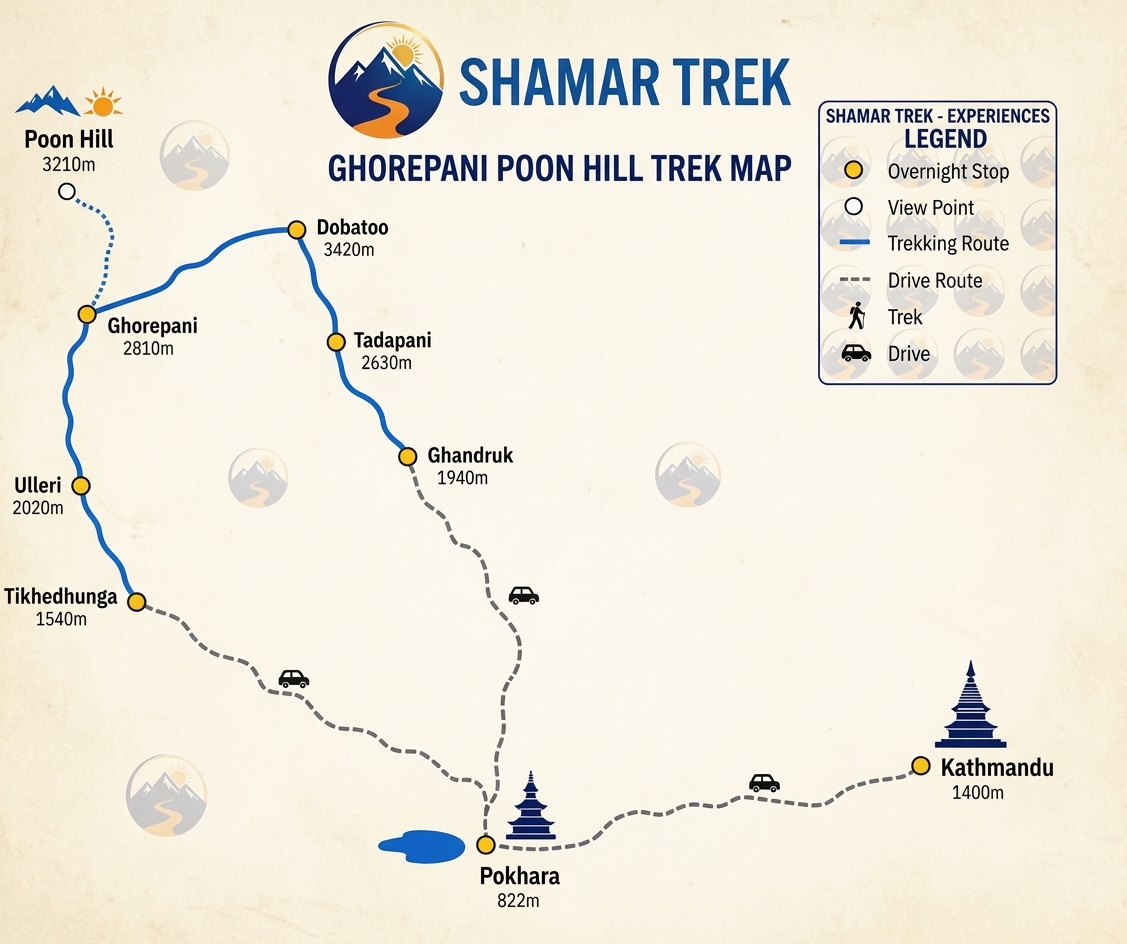
Route map image could not be loaded
Showing route for Ghorepani Poon Hill Trek
Route Information
Starting Point:Ulleri
Ending Point:Ghandruk
Highest Point:Poon Hill (3,210 m)
Key Locations
Ulleri
Day 1
start
1,960 m
Ghorepani
Day 2
2,874 m
Poon Hill
Day 3
viewpoint
3,210 m
Tadapani
Day 3
2,630 m
Ghandruk
Day 4
end
1,940 m
Frequently Asked Questions
Graded easy, and most reasonably active people manage it comfortably. The one genuine challenge is the stone staircase to Ulleri on day one — around 3,000 steps. There is no altitude risk and no technical ground. The descents on days three and four are harder on knees than anything is on lungs.
Still have questions?
Our travel experts are here to help you plan the perfect trip. Get in touch with us for personalized advice.
Reviews & Ratings
—
0 reviews
5★
0
4★
0
3★
0
2★
0
1★
0
Share Your Experience
Have you completed this trek? Help other travelers by sharing your experience.