
Annapurna Region, Nepal
Muldai View Point Trek
Four days to a viewpoint 427 m higher than Poon Hill, on the same side of the same mountains, with a fraction of the people on it — Tadapani, the Dobato ridge, and a sunrise at Muldai.
Package Overview
Best Time to Visit
March to May, September to December
Guided & Permitted
Licensed, insured guide and all trekking permits included
The viewpoint that solved Poon Hill's problem
Poon Hill has a queue. On a clear October morning several hundred people stand on a platform built for a fraction of that, and the photograph everyone came for has somebody's head in it. The mountains are extraordinary. The experience of looking at them is not.
Muldai View Point sits at 3,637 m on the ridge north of Ghorepani — 427 m higher than Poon Hill, facing the same mountains from a position several kilometres closer to them. On most mornings in season you will share it with fewer than a dozen people. Some mornings you will have it to yourself.
That is the entire proposition of this trek, and it is worth being direct about it: you are paying a slightly harder walk and one extra category of effort in exchange for a better version of the most photographed sunrise in Nepal.
What you can actually see from the top
Muldai's advantage is geometric rather than just vertical. The ridge runs east–west, which puts Dhaulagiri on your left, the Annapurna wall in front, and Machhapuchhre round to the right — an uninterrupted arc rather than a view over an intervening hill.
| Peak | Height | Where it sits from Muldai |
|---|---|---|
| Dhaulagiri I | 8,167 m | West, across the Kali Gandaki gorge |
| Annapurna I | 8,091 m | North-west, behind the nearer wall |
| Annapurna South | 7,219 m | North, the dominant face |
| Machhapuchhre | 6,993 m | North-east, in profile |
| Nilgiri South | 6,839 m | North-west, beyond Annapurna South |
| Hiunchuli | 6,441 m | North, immediately right of Annapurna South |
Two eight-thousanders in one frame, from a hill you walk up in trainers-and-poles terms. There are not many places in the world where that sentence is true.
Why the trek is four days and not three
You could drive further and walk faster. Operators selling a three-day version get you to Dobato by pushing a long first day from the roadhead, and the cost is landing at 3,420 m having gained roughly 1,800 m in under thirty hours.
Sleeping at Tadapani (2,630 m) on night one breaks that gain in half. It is not a token stop — it is the difference between watching the sunrise and lying in a lodge with a headache while other people watch it. At these altitudes serious mountain sickness is uncommon, but a wrecked night and a thumping head are very common indeed, and entirely avoidable.
Difficulty, told straight
This is a moderate trek and the moderate part is the stone. The Annapurna foothills are built on flagged staircases, some of them thousands of steps long, and the descent from Dobato to Ghandruk on day three drops nearly 1,500 m almost entirely on them.
Uphill you will be out of breath. Downhill you will feel it in your knees and the fronts of your thighs. Trekking poles change that day more than any other piece of equipment, and we say so to every client who asks whether they are worth the bother.
| Day | Walking | Net height change | The hard part |
|---|---|---|---|
| 1 | 4–5 hrs | +1,000 m from the roadhead | Steps above Kimche, in afternoon heat |
| 2 | 5–6 hrs | +790 m | Sustained forest climb, thinning air at the top |
| 3 | 6–7 hrs | +217 m then −1,697 m | The descent, all of it |
| 4 | Drive | — | Nothing |
Dobato is one place, not a village
Tadapani and Ghandruk are settlements with competing lodges, shops and a choice of dinner. Dobato is a handful of buildings on a saddle and nothing else — no village, no shop, no signal worth the name.
In practice: bed spaces are limited and in late October they fill, so we book rather than arrive and hope. Rooms are plywood-partitioned and unheated, the dining room stove is the only warm place, and the menu is short. Water is scarce enough that a hot shower may simply not be available, whatever the sign says.
None of this is a complaint. It is why Muldai is quiet — there is no capacity for a crowd — and it is the trade you are making.
Muldai or Poon Hill? An honest comparison
| Muldai View Point | Poon Hill | |
|---|---|---|
| Summit altitude | 3,637 m | 3,210 m |
| People at sunrise, peak season | Usually under twenty | Often several hundred |
| Hardest day | The Dobato descent | The steps to Ulleri |
| Lodges | Basic; Dobato has no alternatives | Comfortable, plenty of choice |
| Suits | Second or third trek in Nepal | A genuine first trek |
If this is your first multi-day walk anywhere, take Poon Hill instead and accept the company. If you have walked in Nepal before, or you have walked multi-day elsewhere and simply want the good version, this is the one.
Where it fits with the longer treks
Muldai sits on the return leg of the seven-day Khopra Danda trek, so the two overlap on their final days. If you have a week rather than four days, Khopra includes this viewpoint and adds Khayer Lake and the Khopra ridge — better value per day, and a genuine circuit with no repeated ground.
The trek also shares its first day and its last with the route to Annapurna Base Camp, which is why some clients run the two back to back with a rest day in Ghandruk between them.
Season, and the one month people overlook
Spring, from March to May, puts the rhododendron forest between Tadapani and Dobato into flower — this stretch is genuinely among the best in the Annapurnas for it, and the trees here are old and tall rather than shrubs. Autumn, late September to November, gives the cleanest air and the sharpest mountains.
December is underrated on this route. The air is at its clearest, the lodges are close to empty, and the trail is below the snowline in most years. It is cold — well below freezing at Dobato overnight — and that is the whole reason nobody is there.
We do not recommend June to August. The mountains are behind cloud, the steps are slick, and the lower forest has leeches.
Permits
Two, both included in the price and both arranged by us before you leave Pokhara:
- ACAP — Annapurna Conservation Area Project entry permit
- TIMS — Trekkers' Information Management System card
Bring your passport and two passport photographs. The checkpoint at Birethanti or Kimche will ask for both, and the Ghandruk ACAP post records your details for search and rescue.
Where this trek goes
- Pokhara — A lakeside town at 820 m with the Annapurnas 30 km away
Related activities: Trekking in Nepal.
Or compare every trip we run: all trekking and tour packages.
Trip Highlights
Muldai View Point (3,637 m) — higher than Poon Hill, without the crowd
Dhaulagiri, Annapurna South, Annapurna I, Hiunchuli and Machhapuchhre from one ridge
The Tadapani–Dobato rhododendron forest, among the best stretches in the Annapurnas
Two nights in a single-cluster lodge settlement rather than a trekking town
Ghandruk, the Gurung village that funded much of ACAP's early conservation work
Four days from Pokhara with no internal flight
Live Weather
Detailed Itinerary
1
Day 1: Pokhara to Tadapani (2,630 m)
Drive two to three hours to the roadhead at Kimche, then walk four to five hours up through Ghandruk and into the forest to Tadapani. The climb from Kimche is stone steps in open sun, so we leave Pokhara early to get the worst of it done before the heat. Tadapani means "far water" and sits in a clearing with Annapurna South and Machhapuchhre framed directly up the valley — a view you get from the lodge terrace without walking another step.
2
Day 2: Tadapani to Dobato (3,420 m)
Five to six hours, and the best forest day of the trek. The trail climbs steadily north through old rhododendron and oak — in April the canopy here is red and pink overhead rather than at eye level — before the trees thin into scrub and the ridge opens out. Dobato is a small cluster of lodges on a saddle at 3,420 m. Afternoons are often clear and the evening cold arrives fast once the sun drops behind the ridge.
3
Day 3: Muldai View Point (3,637 m) at sunrise, then descend to Ghandruk (1,940 m)
Up in the dark for a forty-five minute climb to the viewpoint, arriving before first light. Dhaulagiri catches the sun first, then the Annapurnas, then Machhapuchhre. Back to Dobato for breakfast, then the long descent — through Isharu and Tadapani and down nearly 1,500 m of stone staircase to Ghandruk. Six to seven hours in total and the day your knees will remember. Ghandruk is a proper Gurung village with a museum worth an hour and hot showers that actually work.
4
Day 4: Ghandruk to Pokhara
A short walk down to the road at Kimche and a two to three hour drive back to Pokhara, arriving around midday. If you would rather spend the morning in Ghandruk, the village is one of the most photographed in Nepal for good reason and the drive can be pushed to the afternoon.
Cost Details
What's Included
- Private vehicle, Pokhara to Kimche and return
- All lodge accommodation on trek, twin share
- Breakfast, lunch and dinner throughout the trek
- Pre-booked rooms at Dobato, where beds are limited
- Licensed, insured English-speaking trekking guide
- ACAP entry permit and TIMS card
- Guide wages, insurance, food and accommodation
- First aid kit carried by the guide
- Government taxes and company service charge
What's Not Included
- International flights and Nepal visa
- Travel insurance — must cover helicopter evacuation
- Accommodation and meals in Pokhara
- Porter — available on request at a daily rate
- Hot showers, wifi, battery charging and bottled drinks in lodges
- Personal trekking equipment, sleeping bag and poles
- Tips for guide and porter
- Any cost arising from early descent or trip changes
Essential Information
- Maximum altitude: 3,637 m
- Trip duration: 4 days
- Difficulty: moderate
- Best season: March to May, September to December
- Group size: 1 to 12 trekkers
- Permits: ACAP entry permit; TIMS card — all included and arranged by us
- Accommodation: Lodges on trek, twin share
- Guide: licensed and insured, English speaking
- Weather reference point: Ghandruk
Important Cost Information
Payment Terms:
- • 25% deposit required to confirm booking
- • Balance payment due 30 days before departure
- • Full refund if cancelled 45+ days before
Fixed Departure Dates
Choose from our scheduled group departures with guaranteed departures.
Route Map
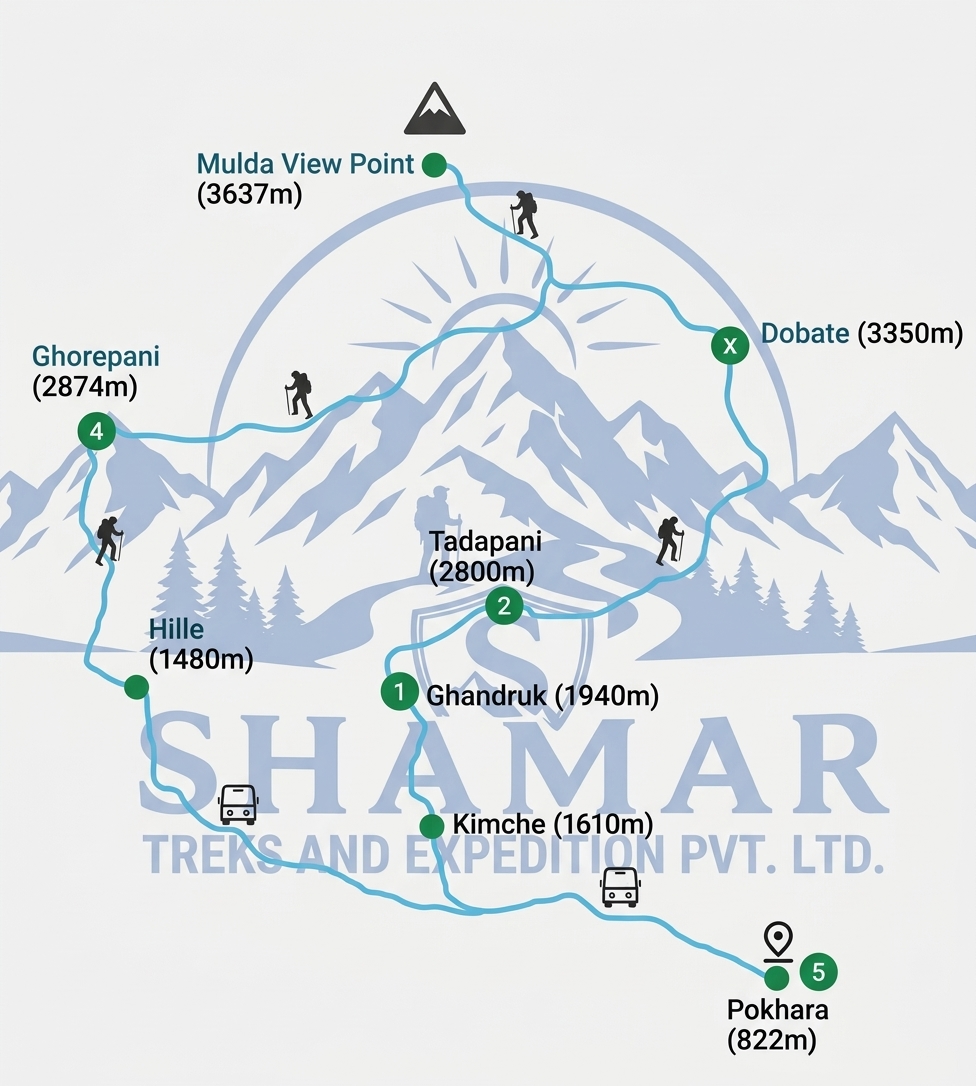
Route map image could not be loaded
Showing route for Muldai View Point Trek
Route Information
Starting Point:Kimche
Ending Point:Ghandruk
Highest Point:Muldai View Point (3,637 m)
Key Locations
Kimche
Day 1
start
1,640 m
Tadapani
Day 1
2,630 m
Dobato
Day 2
3,420 m
Muldai View Point
Day 3
viewpoint
3,637 m
Ghandruk
Day 3
end
1,940 m
Frequently Asked Questions
Muldai View Point is 3,637 m. That is 427 m higher than Poon Hill and makes it the highest point on this trek. You sleep at Dobato, 3,420 m, and climb to the viewpoint for sunrise rather than staying on top.
Still have questions?
Our travel experts are here to help you plan the perfect trip. Get in touch with us for personalized advice.
Reviews & Ratings
—
0 reviews
5★
0
4★
0
3★
0
2★
0
1★
0
Share Your Experience
Have you completed this trek? Help other travelers by sharing your experience.