Guides and Porters in Nepal: The Rules, and What Is Fair
Anos Tamang
Founder and trekking guide, Shamar Treks
Two things changed recently in how trekking in Nepal is staffed and permitted, and a great deal of published advice has not caught up with either. This is where the rules actually stand, and what counts as fair treatment of the people carrying your bag.
You need a licensed guide on most routes
Since 1 April 2023, foreign trekkers in Nepal's national parks and conservation areas are required to be accompanied by a licensed guide working for a registered trekking agency. Genuinely independent trekking — the way people walked the Annapurna Circuit in the 1990s — is no longer permitted on the main routes.
The rule is enforced at checkpoints, where your guide presents their licence and your permits are recorded. It is not a formality anybody talks their way past.
Opinions on the rule differ. The stated purpose is safety and traceability, and the practical effect is that somebody official knows where you are — which is the mechanism by which anyone would come looking. Whatever you make of it, planning a trip that ignores it does not work.
The restricted-area rule changed in March 2026
This one is genuinely new and most sites still have it wrong.
Restricted areas — Upper Mustang, Manaslu and Tsum, Nar Phu, Kanchenjunga, Dolpo, Humla and others along the northern border — used to require two trekkers on one permit. A solo traveller could not be issued one, and people were turned back at checkpoints such as Jagat for exactly that reason.
In March 2026 the Department of Immigration dropped that requirement, following a submission from the Trekking Agencies' Association of Nepal. A solo foreign trekker can now be issued a restricted-area permit individually.
What did not change:
- The permit is still issued only through a registered Nepali agency — you cannot buy one yourself.
- A licensed guide is still mandatory.
- Independent trekking in these areas is still not permitted.
If a page you are reading still says you must find a second person to visit Upper Mustang, it has not been updated since early 2026. Our permits guide sets out what each region needs.
Guide, porter, or porter-guide?
| Role | What they do | Carries |
|---|---|---|
| Guide | Route, lodges, permits, altitude monitoring, translation, and the decision to turn around | Their own kit only |
| Porter | Carries your duffel. Does not guide and often speaks limited English | ~20 kg between two trekkers |
| Porter-guide | Carries a lighter load and gives basic route help | ~10–15 kg |
A porter-guide is cheaper and is what budget quotes often mean by "guide". They are usually less experienced, less likely to be licensed, and carrying weight — which matters when the job includes assessing whether you are acclimatising. On a high trek, that is the wrong economy.
Should you hire a porter?
It is the single thing that most changes how much you enjoy a long trek, and the case against it is usually pride rather than money.
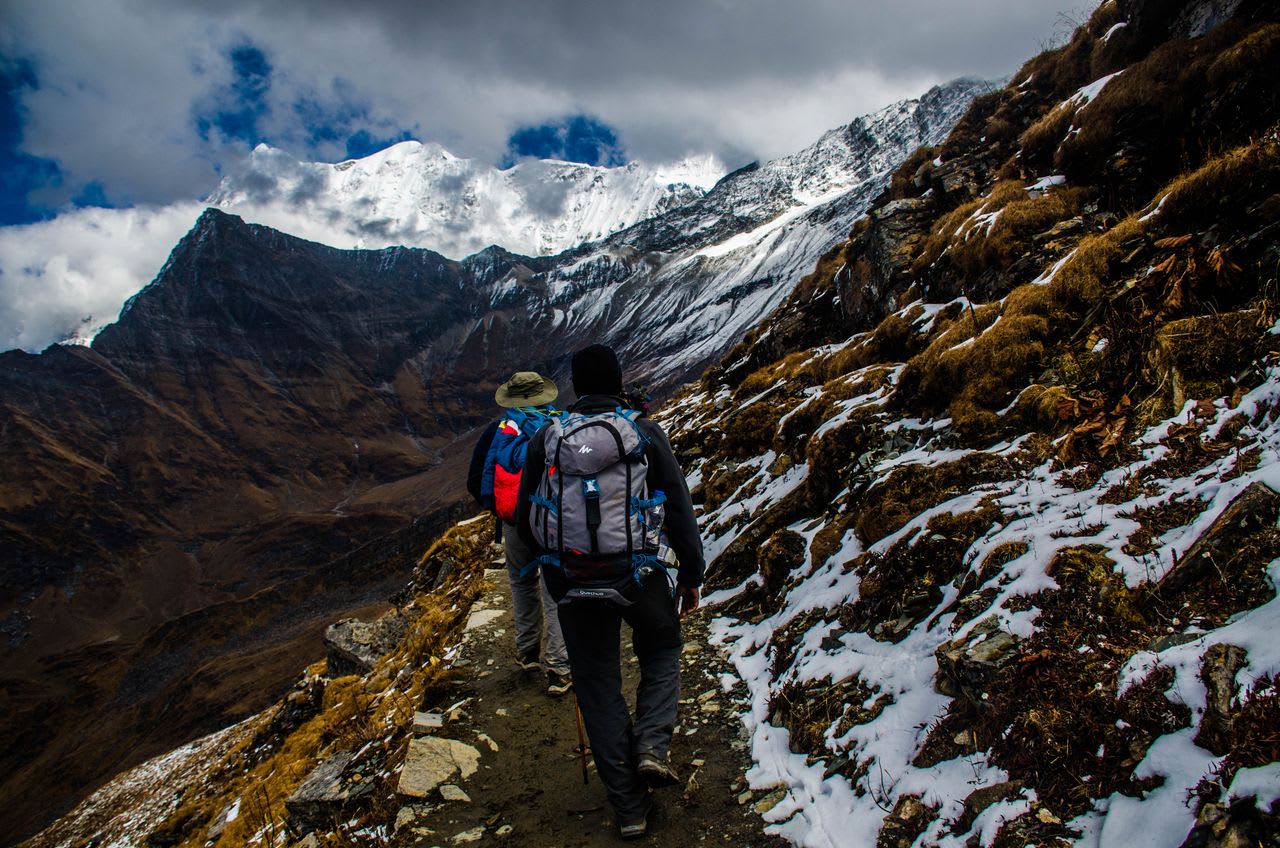
With a porter you carry a daypack — water, layers, camera, documents, perhaps 6 to 8 kg. Without one you carry everything, including the sleeping bag and down jacket, for six to eight hours a day at altitude. By day eight the difference is not subtle.
It is also one of the few reliable sources of cash income in the districts these trails run through, and porters are hired locally.
What fair treatment looks like
Porter welfare is the industry's real ethical problem, and the failures are well documented: overloading, inadequate clothing at altitude, and being sent down alone when ill.
The standards to expect, and to check:
- A load limit that is respected. Around 20 kg between two trekkers is the norm; more than about 25 kg for one porter is not acceptable regardless of what they say they can carry.
- Proper clothing and footwear for the altitude they are going to, supplied by the operator — not flip-flops on a pass.
- Insurance, including rescue and medical. Ask whether the porters on your trip are insured. The answer tells you a great deal about the operator.
- Food and accommodation at the same lodge as you, included, not a stipend to sleep in a storeroom.
- The same treatment when ill as a client. A sick porter should be escorted down, not sent.
These are your questions to ask before booking, and they are reasonable ones. An operator who is doing it properly will answer immediately.
Weight, in practice
Your duffel should be packed to what was agreed, not to what fits. Hotels in Kathmandu and Pokhara store the rest free. If you find yourself thinking "it is only a couple of kilos more", remember it is a couple of kilos more for eight hours a day for two weeks, uphill, at 4,000 m.
Tipping
Customary, and genuinely part of the income rather than a bonus. There is no fixed rate. The useful framing is a proportion of the trip cost rather than a per-day figure, given at the end, and handed to the guide and the porters separately rather than as one lump for someone else to divide.
Ask your guide what is normal. It is not a rude question and you will get a straight answer.
Checking a guide is licensed
Licensed guides carry a Nepal Tourism Board licence with a photograph, and it is presented at every checkpoint anyway. You are entitled to ask to see it, and to ask which agency employs them — the licence belongs to a person, but the legal requirement is that they work for a registered agency.
Every trip we run includes a licensed, insured guide, with wages, insurance, food, accommodation and equipment covered in the price rather than left to you. What is included and excluded is listed in full above the booking form on each trip page.
About Anos Tamang
Founder and trekking guide, Shamar Treks
Anos Tamang is the founder of Shamar Treks and a working trekking guide. He leads trips across Nepal's trekking regions and writes here about the practical side of them — routes, permits, seasons and the decisions that make the difference on the trail.